
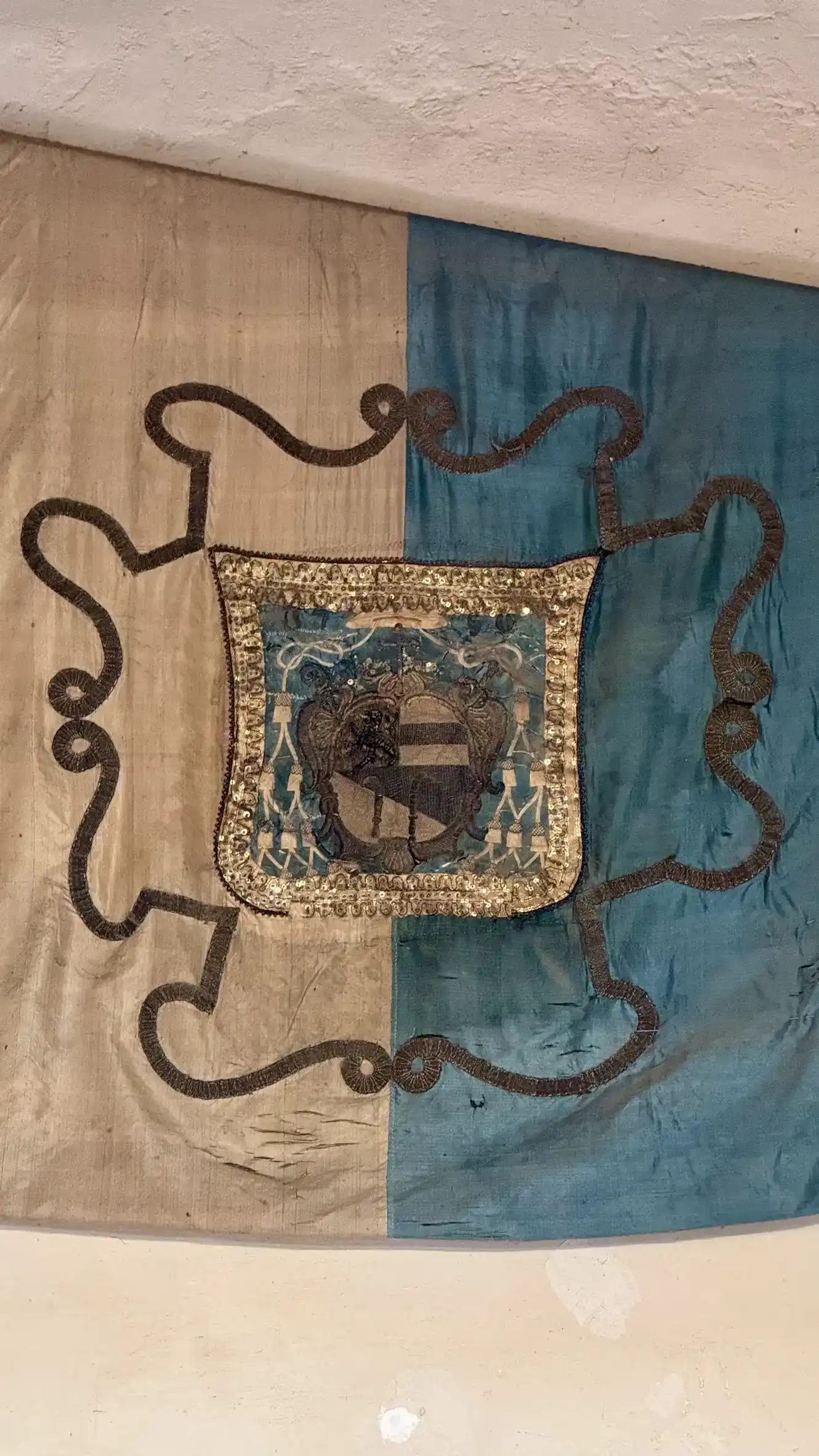
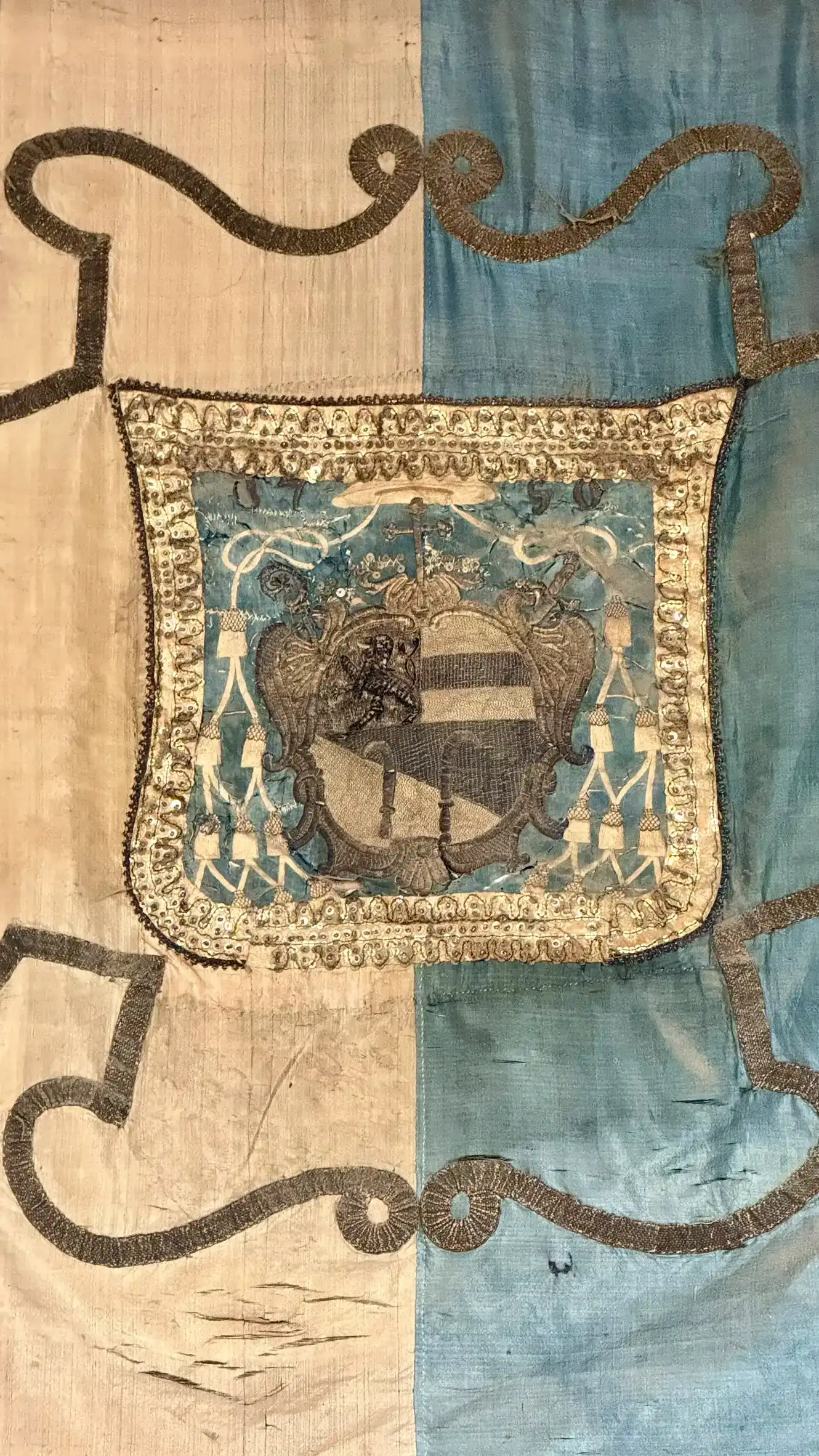

Ceremonial Banner of Andreas Jakob von Dietrichstein
Silk with Metallic Embroidery, 18th Century
Reading Time: 0:46 min
Introduction
The elegant ceremonial banner of Andreas Jakob von Dietrichstein, Prince-Archbishop of Salzburg, combines heraldic and ecclesiastical symbolism characteristic of high-ranking prelates in the 18th century.
Form and Materials
The rectangular banner consists of four vertical silk fields in white, pale beige, blue, and yellow, joined by visible seams. The fabric shows signs of age, with gentle creasing and wear along the folds.
Embroidered Border
A broad embroidered border in gilt thread frames the centre, forming a cartouche-like outline of scrolling loops and curves that accentuates the importance of the central emblem.
Central Emblem
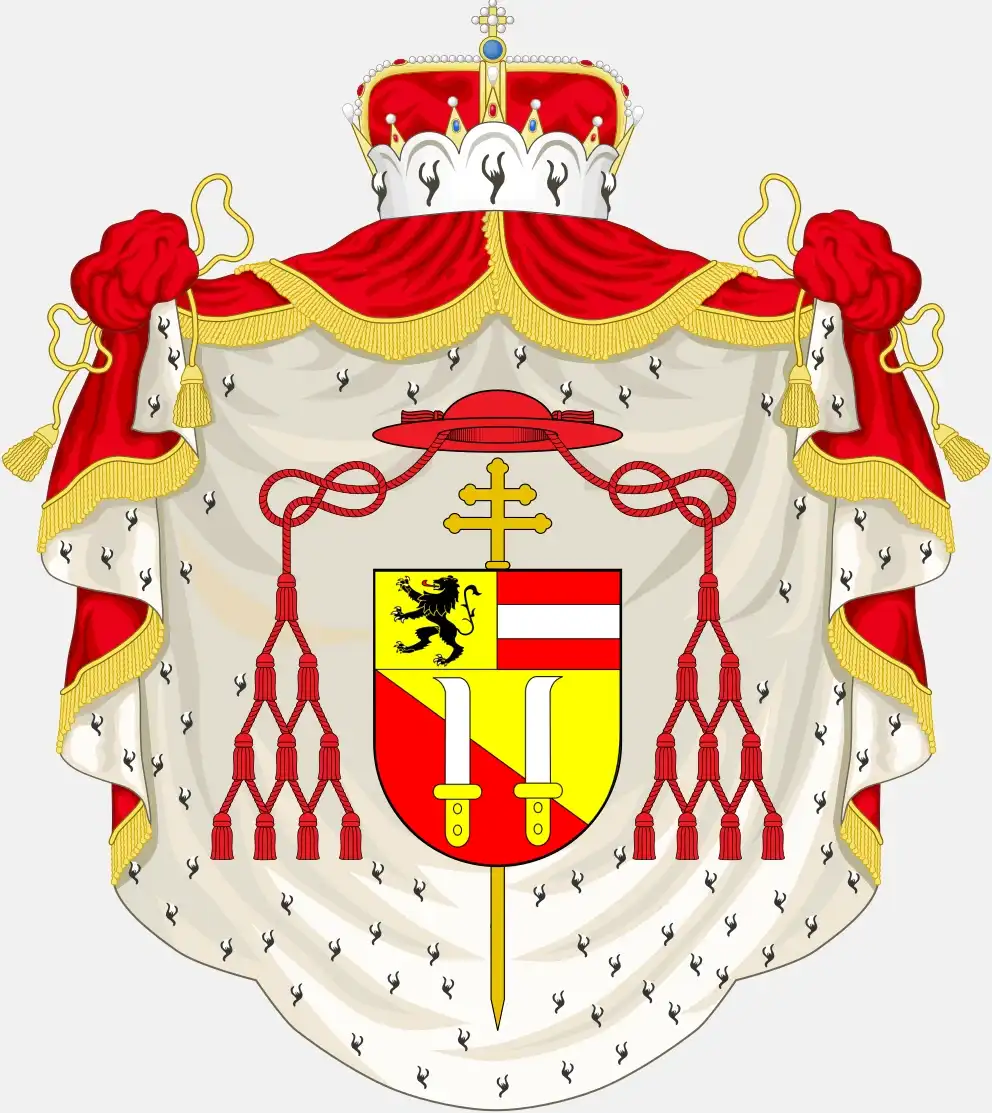
At the centre is the finely embroidered coat of arms of Andreas Jakob Graf von Dietrichstein, enclosed within an ornamental shield-shaped panel edged with metallic thread and sequins. The heraldic design displays the Dietrichstein family arms.
Ecclesiastical Insignia and Symbolism
The central emblem displays ecclesiastical insignia. A galero can be seen above the coat of arms. The galero has tasselled cords. A processional cross crowns the coat of arms.
These insignia denote archiepiscopal authority.
Andreas Jakob von Dietrichstein | Biography
Reading Time: 0:58 min
Andreas Jakob von Dietrichstein was born on 27th May 1689 in Iglau (now Jihlava, Czech Republic) and belonged to the Moravian branch of the Dietrichstein family.
After studying in Salzburg, he became a canon in 1713, followed by the roles of dean in 1729 and provost in 1730.
Upon the death of his predecessor, he was elected Archbishop of Salzburg in 1747. His election was a compromise, as while the citizens of Salzburg had hoped for a local noble, the cathedral chapter favoured a foreign candidate.
He was consecrated bishop in 1749 by Bishop Joseph Maria von Thun and Hohenstein. Throughout his tenure, Dietrichstein promoted fiscal austerity in an effort to resolve the financial issues caused by the previous Protestant expulsion. Despite his efforts, he left his successor with considerable debt.
Culturally, he supported several key projects, including the restoration of the Andreaskirche and the renovation of the Hellbrunn water features, during which the “Mechanical Theatre” was built to replace the decaying Blacksmith’s Grotto.
While Dietrichstein was also a lover of social events and theatrical performances, he was serious and dedicated in his administrative duties.
He passed away on 5th January 1753 and was interred in the crypt of the Salzburg Cathedral.
His motto, “amore et justitia” – “By Love and Justice”, reflected his commitment to fairness and his love for his people.