Altarpiece
Reading Time: 3:20 min
An altarpiece is a work of art that decorates the space above and behind the altar in a Christian church.
Painting, relief, and sculpture in the round (three-dimensional artwork) have all been used in altarpieces, either alone or in combination. These artworks usually depict holy personages, saints, and biblical subjects.
Terms associated with Altarpieces
The predella is a low, decorated strip intended to raise the main part of the altarpiece to a height where it is readily visible from a distance.
A diptych is an altarpiece consisting of two painted panels.
A triptych has three panels.
A polyptych has four or more panels.
A winged altarpiece is one equipped with movable wings that can be opened or closed over a fixed central part, thereby allowing various representations to be exposed to view.
The term reredos is used for an ornamental screen or partition that is not directly attached to the altar table but is affixed to the wall behind it.
The term retable simply refers to any ornamental panel behind an altar.
Altarpiece | History
The practice of erecting a structure above and behind the altar and adorning it with artworks extends back at least to the 11th century.
Sculpture was the dominant element in the altarpieces of the late Middle Ages, especially in Germany and Austria.
Altar paintings, by contrast, became common in northern Europe only in the 15th century.
Renaissance Italy, by contrast, favoured altarpieces consisting of single, monumental paintings in simple gilded frames.
The Baroque artists of the 17th century excelled in the creation of large stage like altarpieces in which painting, sculpture, and florid ornament are dramatically merged.
This flamboyant tradition continued to flourish in Germany, Austria, Spain, and Spanish America well into the 18th century.
Winged Altar | Labelled Image
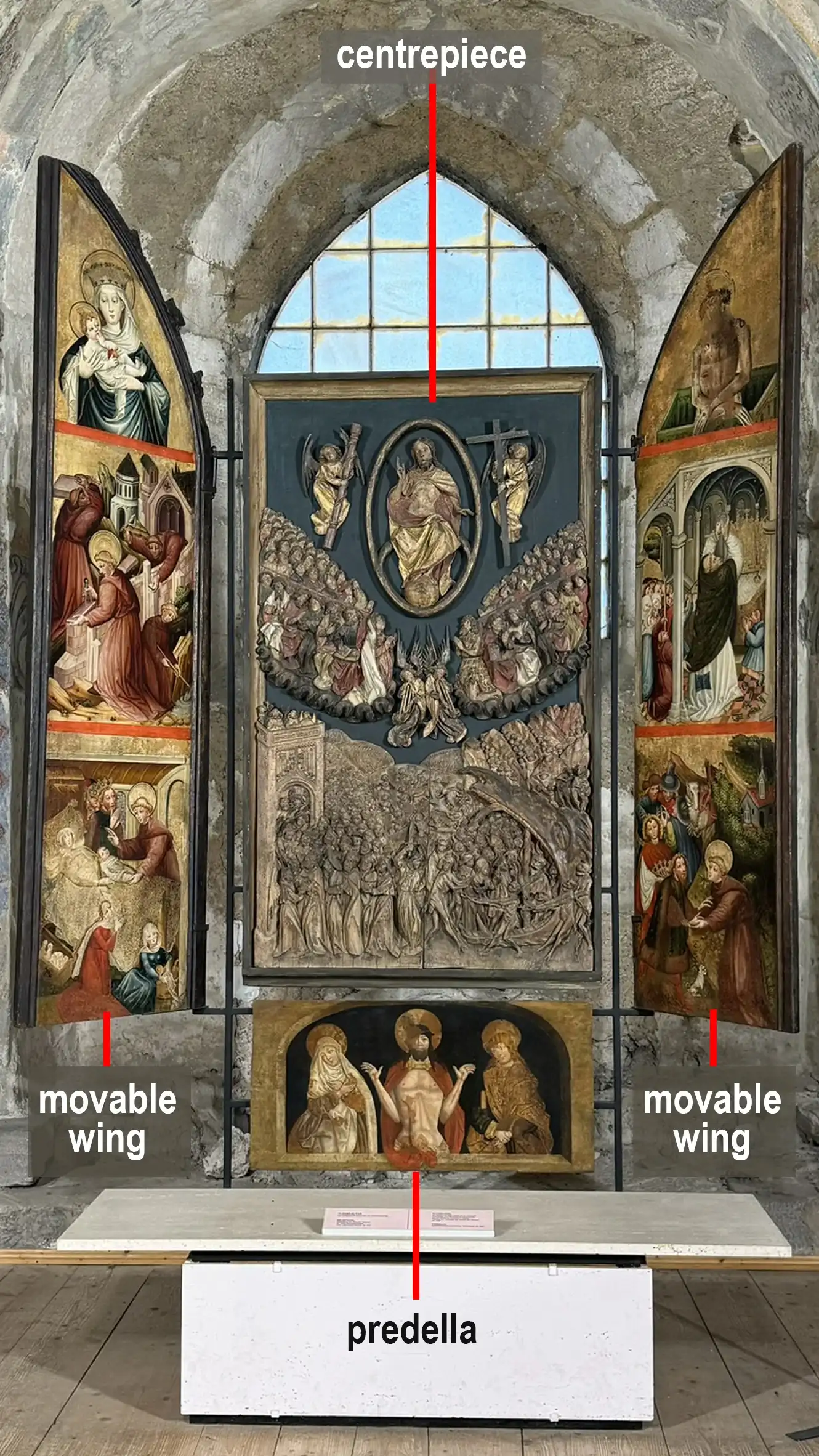
Folding Altar
A medieval folding altar was a portable, collapsible altar used in Catholic churches during the Middle Ages, especially in situations where a permanent altar could not be set up, such as during travel, military campaigns, or for use by itinerant clergy. These folding altars were designed for both convenience and practical use, making it easier to hold Mass in various locations.
Parts of a Folding Altar
- Tabletop: The central, flat surface where the Eucharistic celebration would take place. The tabletop was typically made of wood, though it could be covered with precious materials like cloth or even metal for more important uses.
- Folding Mechanism: The altar had folding sides or panels that could be collapsed or expanded. This allowed it to be easily stored or transported. The folding mechanism often used hinges or joints.
- Decorative Panels: Many folding altars had ornate, carved or painted panels on the sides. These could depict scenes from the life of Christ, saints, or biblical stories. When folded, these panels would often provide a protective covering for the altar and serve as a visual representation of sacred themes.
- Relief or Carved Images: In some cases, the front or sides of the altar could be decorated with carvings of religious figures or motifs. These carvings could be removable or hidden when the altar was folded for transport.
- Base or Support Structure: The folding altar might have a collapsible base or legs that could be folded or extended. This base was designed to be sturdy yet portable.
Function of a Folding Altar
The main function of the folding altar was mobility. It allowed priests to celebrate Mass in places without a fixed altar, such as in private homes, on pilgrimages, during military campaigns, or in temporary churches. They were also useful for clergy who travelled or for monks in monastic settings where altars might not always be readily available.
Folding altars helped to maintain the continuity of worship and liturgical practices, ensuring that Mass could be celebrated properly even in non-permanent locations.
Materials Used
- Wood: The primary material for the altar’s construction, due to its availability and ease of shaping. Often, the wood would be covered with cloth or painted for aesthetic and liturgical purposes.
- Metal: In some cases, parts of the altar, especially the hinges, locks, or decorative details, were made of metal.
- Gold or Silver Leaf: For altars used in more elaborate settings, gilding or precious metals were often applied to add beauty and reverence.
- Cloth: Linen, silk, or other fabrics were used to cover the altar, especially to conceal its folding parts when it was in use. The cloth would also be used for the altar cloth, which was important for liturgical practice.
In summary, the medieval folding altar was an essential piece of liturgical equipment that enabled the celebration of Mass in a variety of settings. It was made primarily of wood, often with metal fittings and decorative elements, and it could be folded and easily transported to accommodate the mobility needs of clergy and the Church.