Stoneware Tankards
Reading Time: 1:30 min
Stoneware Tankards | Craft Techniques
The 17th-century stoneware tankards were produced through a combination of specialised craft forms:
Pottery (stoneware production)
The vessels were formed from clay, shaped on the wheel or in moulds, and fired at high temperatures to create durable stoneware.
Relief modelling (applied decoration)
Decorative elements, such as figures and ornamental bands, were modelled separately and applied to the surface to create raised designs.
Glazing techniques (salt glaze and engobe)
Salt glazing produced a hard, glassy surface, while coloured slip (engobe) was applied to refine the surface and add tonal variation.
Enamel painting
Detailed figural scenes and inscriptions were added using enamel colours, requiring skilled and precise hand-painting.
Metalworking (pewter mounting)
The lids, hinges, and thumbpieces were crafted from pewter and fitted to the ceramic body, combining ceramic and metalworking traditions.
Together, these crafts reflect the integration of ceramic production, decorative artistry, and metalworking typical of high-quality tankards of the 17th century.
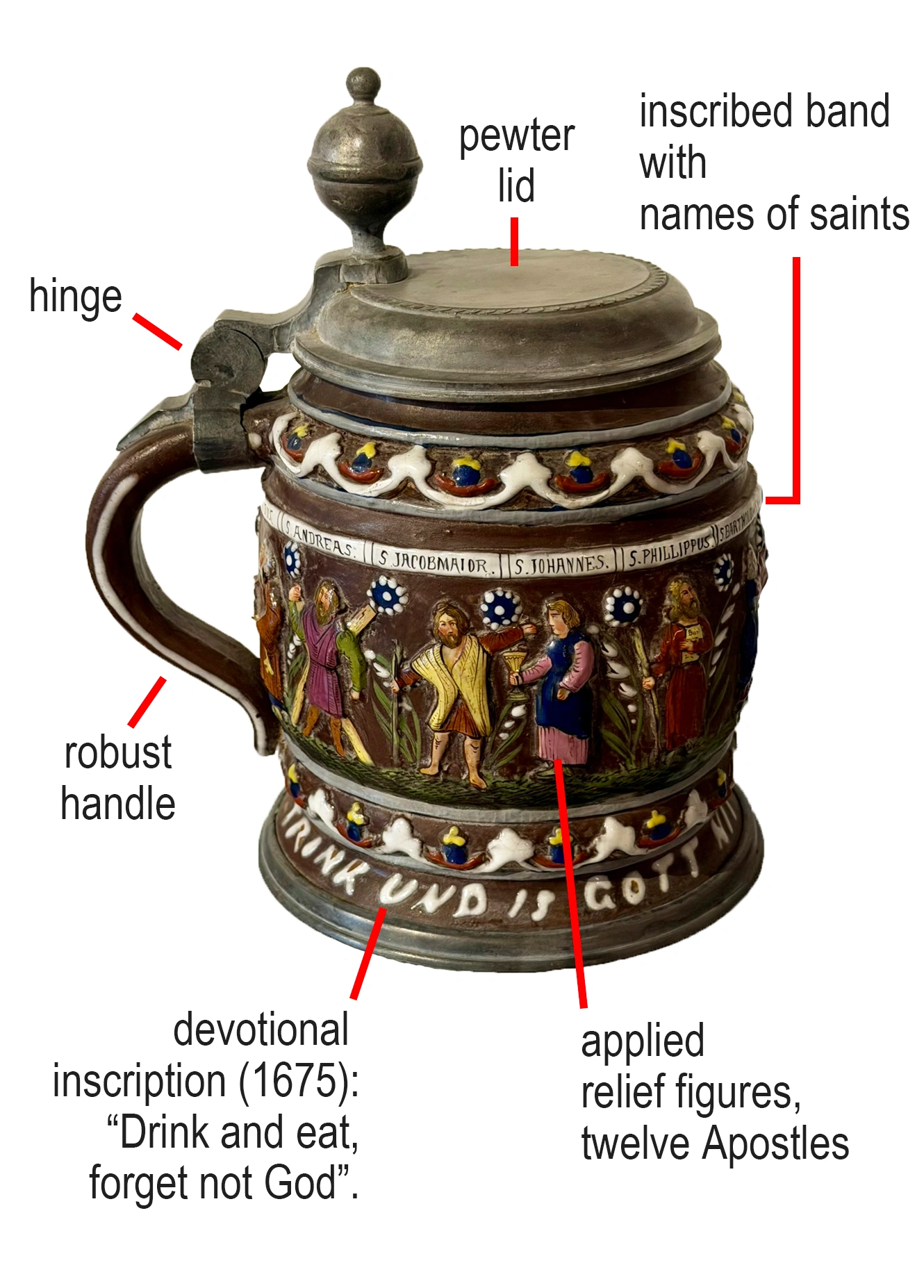
Apostle Tankard | Short Description
This elaborately decorated tankard is made of fired clay and finished with a salt glaze.
It is enamelled with figures of the Twelve Apostles and the Salvator Mundi.
A devotional inscription, dated 1675, reads: “Drink and eat, forget not God”.
The tankard is fitted with an unmarked pewter lid. The style of decoration suggests an origin in Creussen, a centre known for producing similar works.
Planet Tankard | Short Description
This tankard is made of fired clay and finished with a coloured slip (engobe).
It is decorated with applied relief elements and further enriched with enamel painting and a net-pattern design.
The vessel is fitted with an unmarked pewter lid and is attributed to Annaberg in Saxony, dating to the late 17th century.

Tankard depicting the Prince-Electors | Short Description
This tankard is made of fired clay and finished with a salt glaze, and is decorated with applied relief elements.
It is enamelled by the same hand as the Apostle tankard.
The vessel is fitted with a pewter lid bearing an angel mark.
It is attributed to Creussen and probably dates to c. 1670–1680.
