South-Facing Round-Arched Window
Reading Time: 1:50 min
Daylight Exposure and Light Conditions
A round-arched window on the south wall of a higher residential floor in a chapel tower was the most light-rich and climatically responsive of the standard orientations.
Strong Daylight Gain
The south-facing position captured the highest and most consistent sunlight throughout the day. This made the chamber noticeably brighter and reduced reliance on artificial light sources.
Thermal Benefit in Colder Seasons
Solar gain from the south helped to warm the interior naturally, especially in winter. In thick-walled stone towers, this passive heating was a valuable comfort factor in residential spaces.
Enhanced Visibility and Activity Space
The abundance of light made the room suitable for reading, writing, embroidery, or administrative tasks. It effectively extended the usable daytime hours within the tower.
Architectural Expression of Openness
A south-facing window often signalled a more domesticated and less defensive quality. It balanced the fortress-like structure with livable comfort.
Round Arch for Structural Security
As with other orientations, the round arch efficiently transferred the load of the masonry above, allowing a stable opening in an otherwise heavy wall without weakening the tower’s integrity.
Controlled Exposure
Despite increased light, the deep wall thickness and typically modest window size ensured that heat, glare, and weather exposure remained manageable.
Summary
A south-facing round-arched window transformed the chamber through brightness, warmth, and usability, while the Romanesque arch ensured the tower’s structural strength remained uncompromised.
South-Facing Round-Arched Window
Short Description
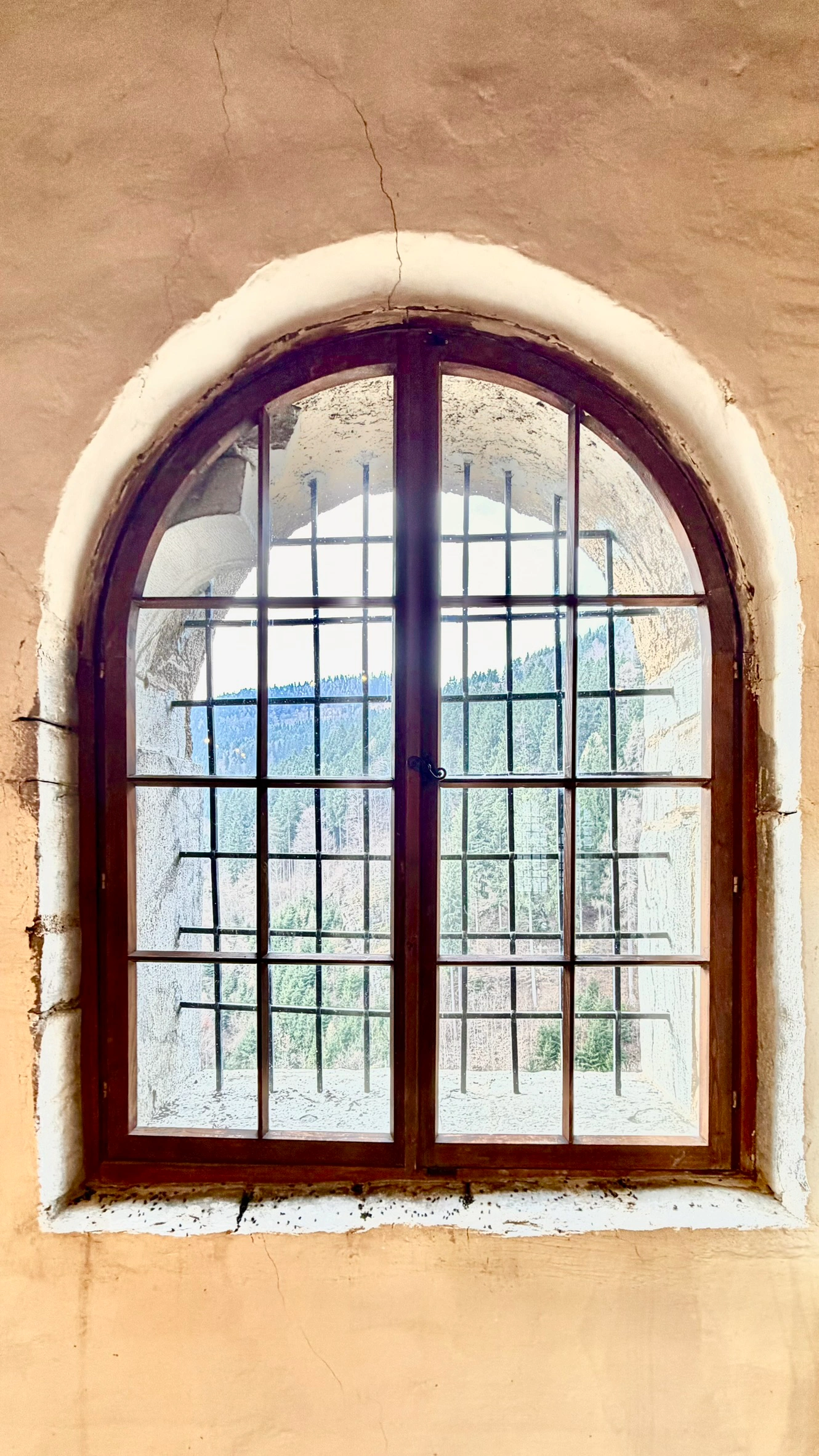
This round-arched window opening, characteristic of Romanesque architecture, is set within the thick wall of the chapel tower. The deep, splayed reveal emphasises the mass of the masonry.
The present timber double casement is a later insertion, positioned towards the inner face and divided by a central mullion and horizontal glazing bars into small panes.
On the exterior, a wrought-iron grille is set close to the outer wall face, providing protection.
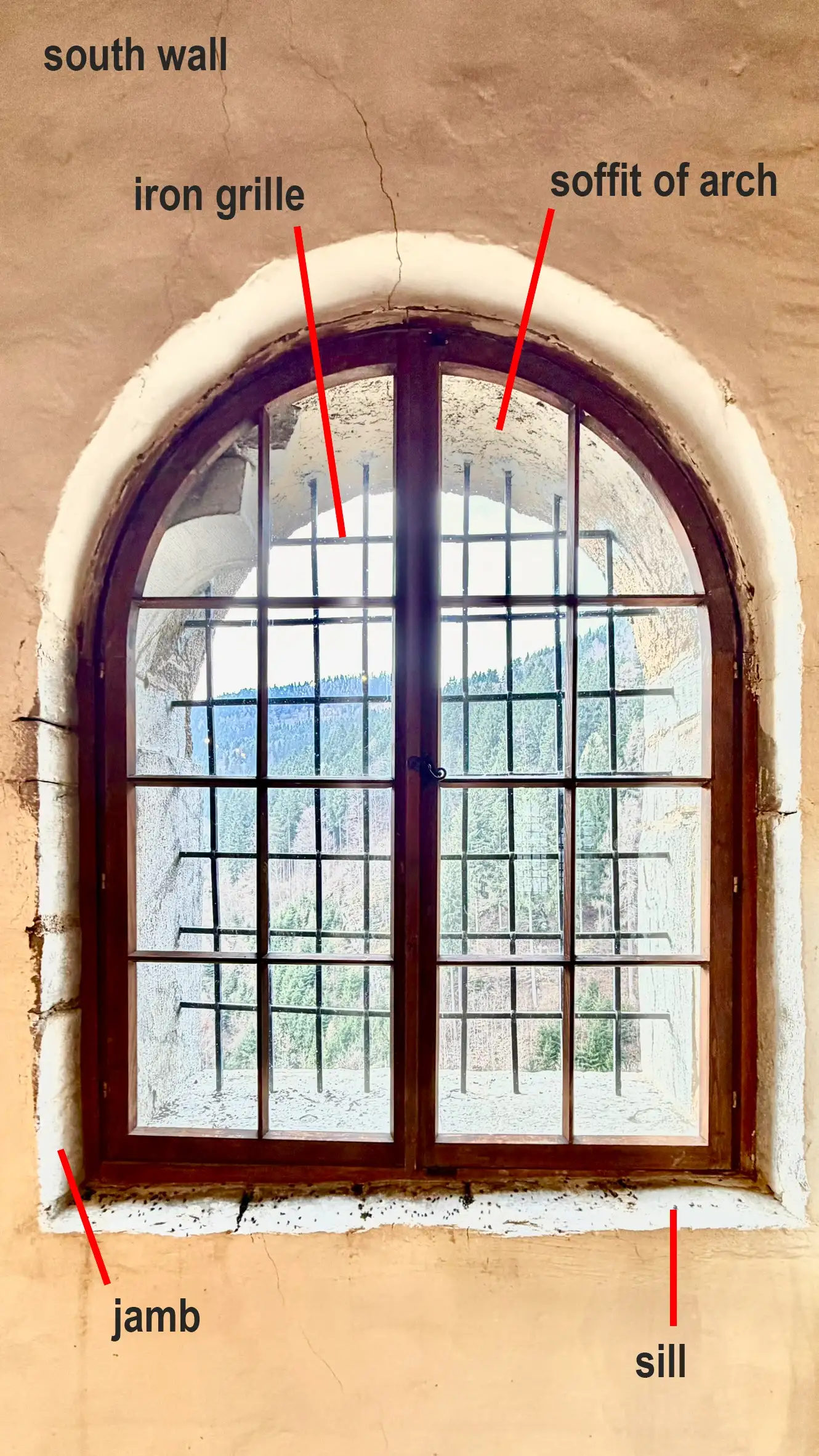
Jambs: These are the vertical sides of the window opening.
Sill: This is the horizontal base of the opening, slightly sloping to shed water.
Soffit of the arch: This is the underside of the arch within the reveal.
Iron grille: This is a metal grid protecting the window.
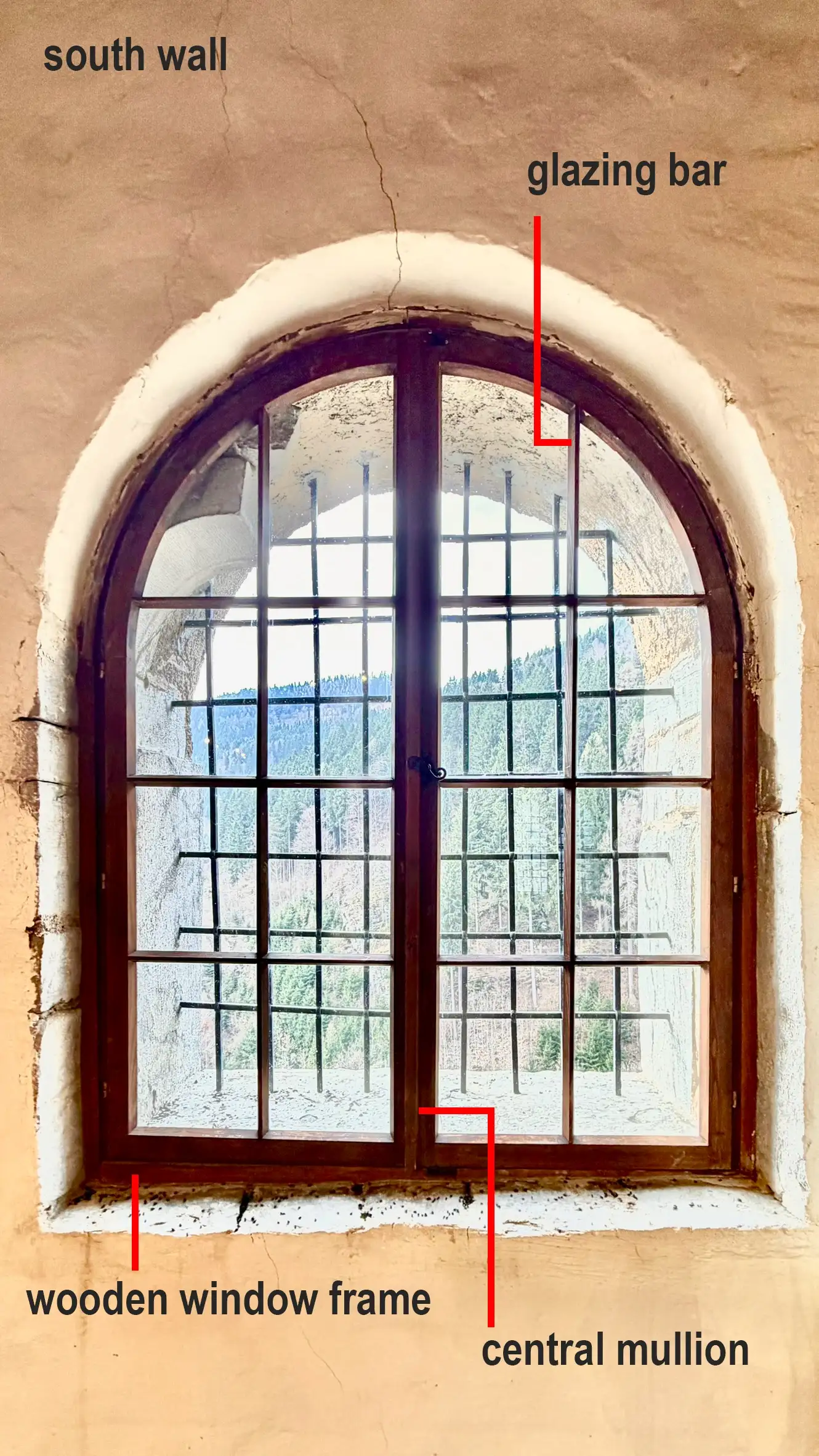
Glazing bars: These are the thin bars that divide the glass panes.
Central mullion: This is the vertical member that divides the window frame.
Wooden window frame: This is the later inserted wooden frame that holds the glazing.
Round-Arched Windows across Architectural Periods
Romanesque (c. 10th–12th Century)
Round-arched windows are small and deeply set within thick masonry walls, often with splayed reveals to admit more light.
Gothic (c. 12th–16th Century)
Round-arched windows are rare and are largely replaced by pointed forms, though they occasionally appear in early or secondary openings.
Renaissance (c. 15th–17th Century)
Round-arched windows are regularly proportioned and symmetrically arranged, reflecting classical models.
Baroque (c. 17th–18th Century)
Round-arched windows are larger and more expressive, often emphasised with mouldings and decorative surrounds.
Neoclassical (c. Late 18th–Early 19th Century)
Round-arched windows are restrained in design, with clear proportions and minimal ornament.
Historicist (19th Century)
Round-arched windows are reinterpreted in revived styles, often with stylised or exaggerated detailing.