String Instruments
Reading Time: 2:30 min
Zither (Alpine Form)
Form
The instrument has a flat, trapezoidal wooden body with a broad lower edge and a narrower upper side, across which multiple parallel strings are stretched over a soundboard with circular sound holes.
Construction
It is constructed as a wooden resonant box with a thin soundboard, and it carries numerous metal strings arranged in melody and accompaniment groups, with tuning pins on one side and hitch pins on the other.
Position
It is placed horizontally on a table or on the player’s lap during performance.
Sound
It produces a clear, delicate, and ringing sound, combining a bright melodic line with a softly resonant accompaniment.
Use
It is used in alpine and rural traditions as well as in domestic music-making, both for solo playing and for accompaniment.
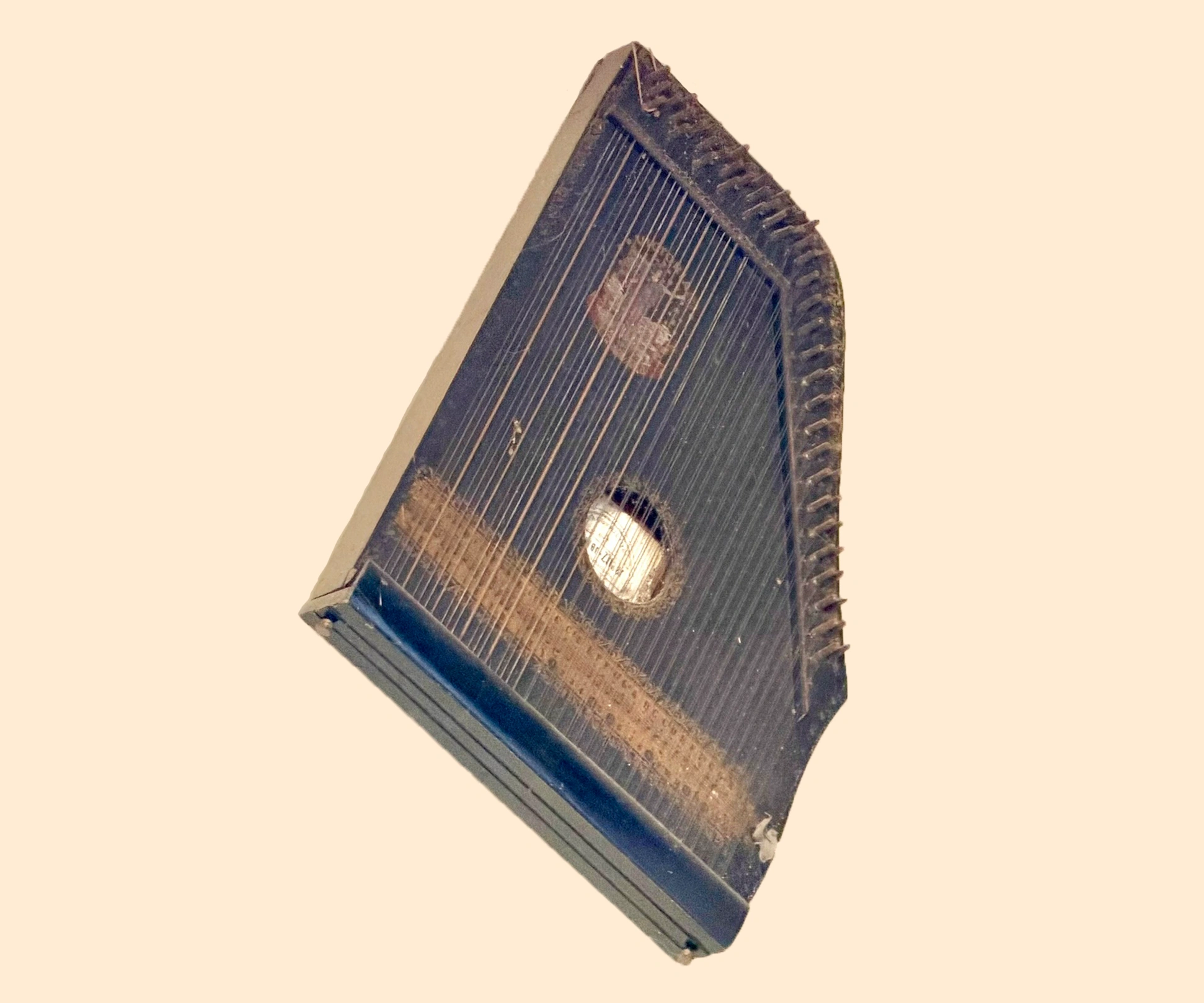
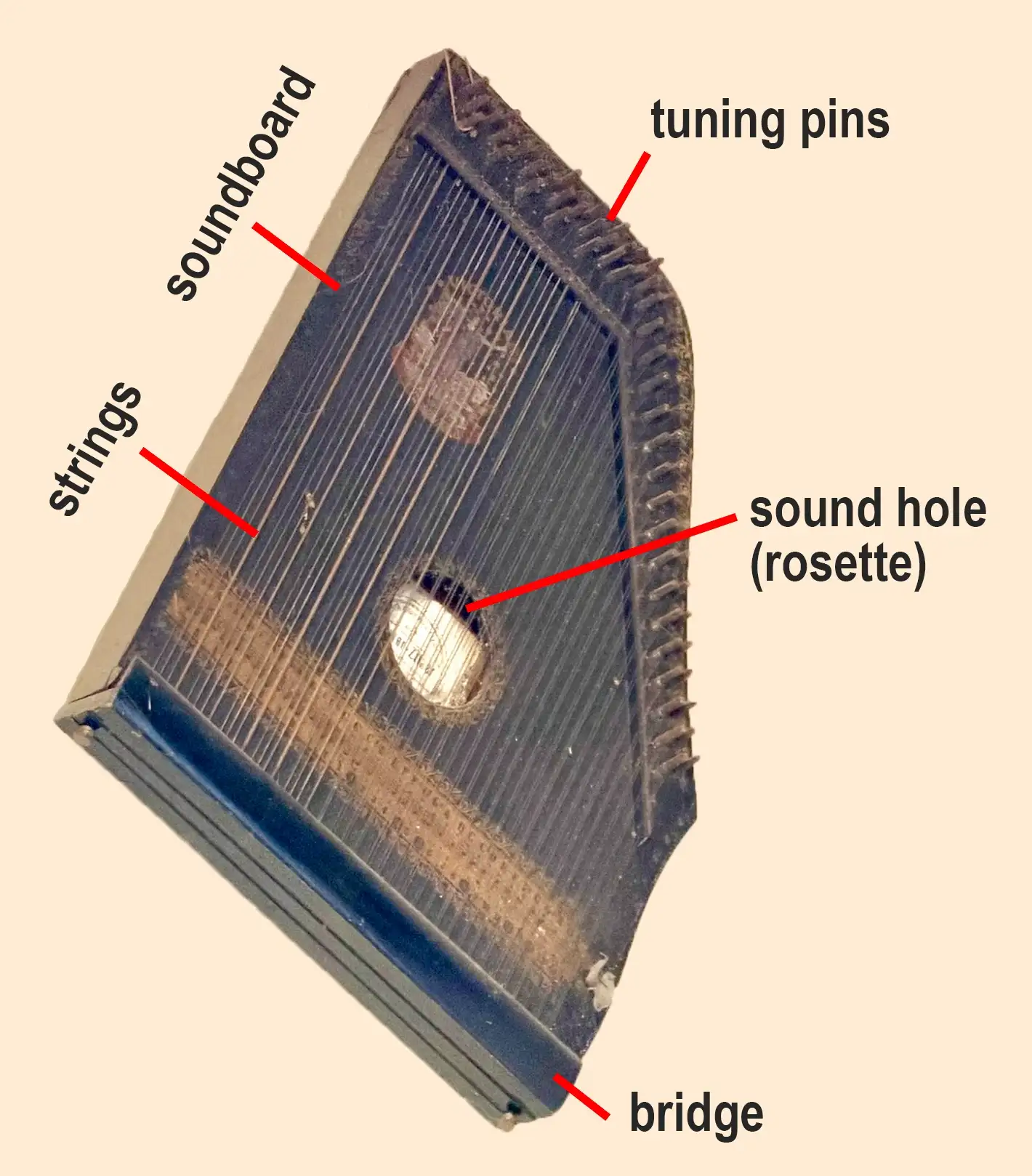
Zither (Alpine Form)
Parts and Locations
Tuning Pins
Arranged along the upper right edge of the instrument, where the strings are tightened and tuned.
Hitch Pins
Located along the opposite (left or lower) edge, anchoring the ends of the strings.
Strings (Melody and Accompaniment)
Stretched across the soundboard from the tuning pins to the hitch pins, running parallel to one another.
Soundboard
The flat front surface of the instrument over which the strings are stretched.
Sound Hole (Rosette)
Circular opening set into the soundboard, typically near the centre, allowing the sound to resonate outward.
Bridge
Positioned across the soundboard, slightly above the lower edge, supporting the strings and transmitting vibrations to the body.
Fretboard (Melody String Area)
Located on one side of the instrument (usually the player’s side), where selected strings are pressed to produce melody notes.
Body (Resonant Box)
The hollow wooden body forming the full depth of the instrument beneath the soundboard.
Frame Edges
The raised outer borders enclosing the soundboard and supporting the string tension.
Pochette (Dance Master’s Violin)
Form
The instrument has a very narrow, elongated wooden body with a simple, almost cylindrical outline, a small pegbox, and minimal shaping, making it compact and easily portable.
Construction
It is constructed from wood with a small resonant body and a short fingerboard, fitted with a few strings and simple tuning pegs, often with minimal ornamentation and a plain finish.
Position
It is held under the chin and played with a bow in the same manner as a violin.
Sound
It produces a soft, thin, and somewhat reedy tone with limited volume, sufficient for close instruction rather than performance.
Use
It was used by dancing masters to demonstrate steps and maintain rhythm during lessons. Its compact size allowed it to be carried in a coat pocket, making it practical for travel.
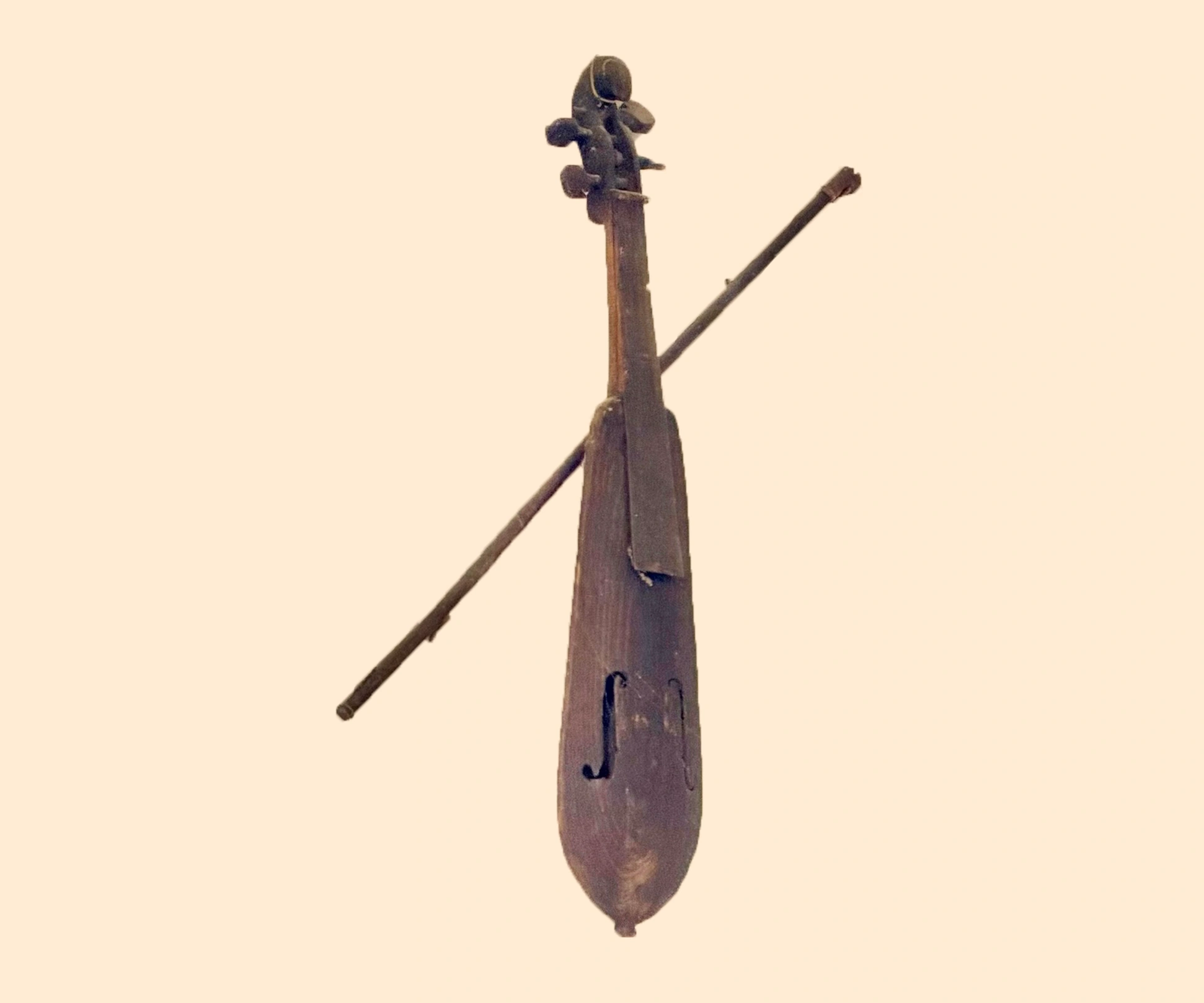
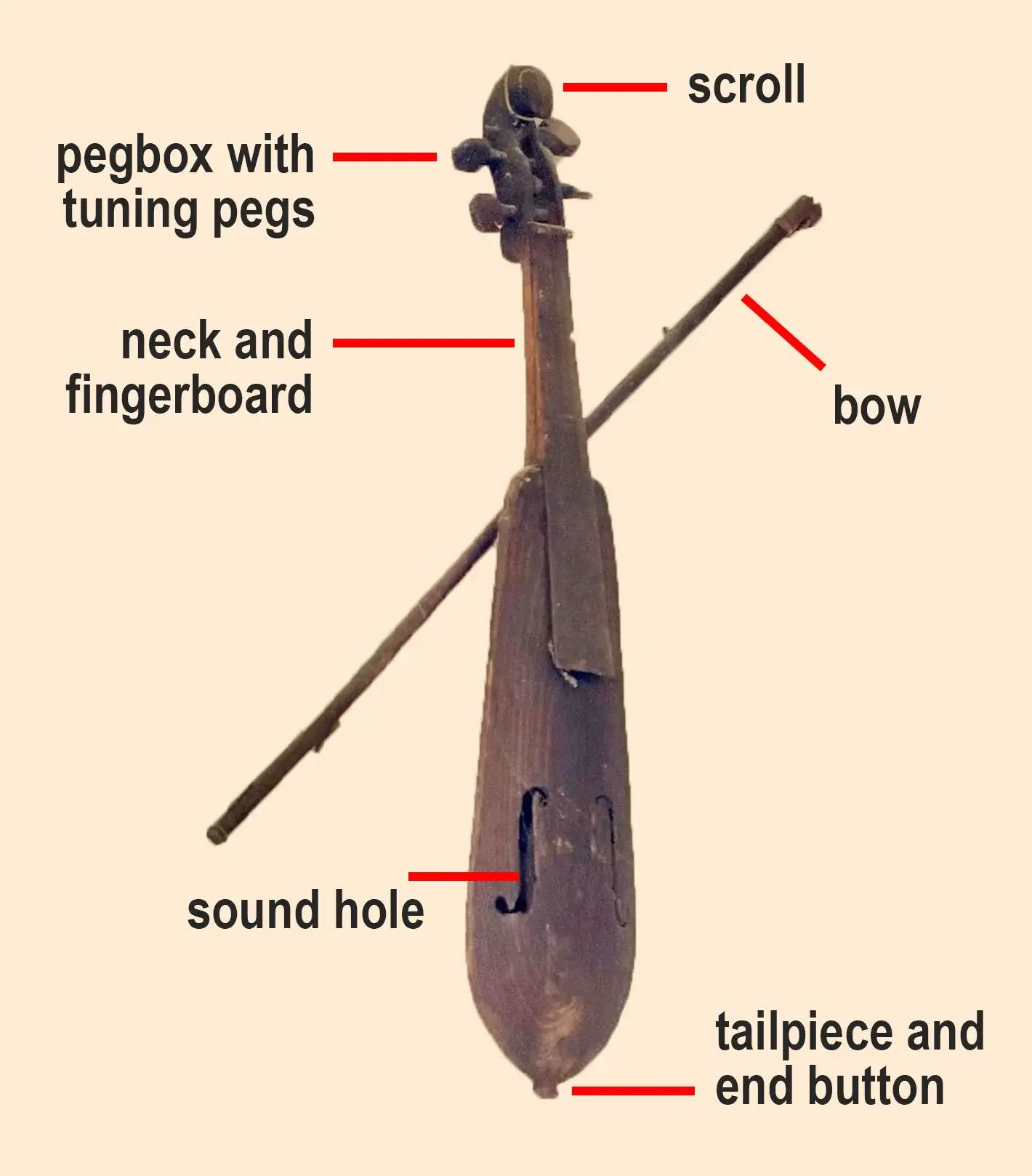
Pochette (Dance Master’s Violin)
Parts and Locations
Scroll
Positioned at the very top of the instrument, forming the carved end of the head.
Pegbox with Tuning Pegs
Located directly below the scroll; the tuning pegs project from either side of the pegbox.
Neck and Fingerboard
Extending downwards from the pegbox; the fingerboard lies along the front of the neck where the strings are pressed.
Strings
Running longitudinally from the pegbox down across the fingerboard and body to the lower end of the instrument.
Elongated Body
Forming the main lower section of the instrument beneath the neck; long and narrow in shape.
Sound Holes
Cut into the front of the body, approximately in the middle section, allowing sound to resonate outward.
Tailpiece and End Button
Situated at the lower end of the body, where the strings are anchored.
Bow
A separate, slender stick held in the hand and drawn across the strings during playing.
String Musical Instruments
(17th–19th Centuries, Carinthia and Austria)
Bowed String Instruments
Violin
Form: Small, waisted wooden body with arched top and back; f-shaped sound holes
Construction: Spruce top, maple back and ribs; four strings; ebony fingerboard
Position: Held under the chin
Sound: Bright, clear, and highly agile
Use: Orchestras, chamber music, church, domestic settings
Viola
Form: Larger than violin; broader body proportions
Construction: Similar materials to violin; four strings tuned lower
Position: Held under the chin
Sound: Warm, mellow, and darker in tone
Use: Inner harmonic voice in orchestras and ensembles
Violoncello (Cello)
Form: Large, deep-bodied instrument with curved outline
Construction: Wooden body; four strings; endpin added in later periods
Position: Played upright between the knees
Sound: Rich, resonant, and lyrical
Use: Bass and melodic roles in orchestras, chamber and church music
Double Bass
Form: Tall, broad instrument; sloping shoulders; long neck
Construction: Wooden body; three or four thick strings
Position: Played standing or seated
Sound: Deep, sonorous, and powerful
Use: Bass foundation in orchestras and civic ensembles
Viol (Viola da gamba)
Form: Flat back; sloping shoulders; fretted fingerboard
Construction: Six or seven strings; lighter build than violin family
Position: Held between the legs
Sound: Soft, delicate, and refined
Use: Courtly and chamber music (mainly 17th century)
Plucked String Instruments
Lute
Form: Pear-shaped body with rounded back; short neck
Construction: Multiple paired strings (courses); carved rosette
Position: Held against the body
Sound: Gentle, intimate, and resonant
Use: Courtly music, accompaniment, solo playing
Harp
Form: Triangular frame with vertical strings
Construction: Wooden frame; numerous strings of varying length
Position: Rested on the ground or against the body
Sound: Clear, shimmering, and sustained
Use: Court, church, and later orchestral settings
Guitar (Early Forms)
Form: Flat, waisted body; smaller than modern guitar
Construction: Wooden body; five or six strings
Position: Held against the torso; plucked or strummed
Sound: Light, clear, and rhythmic
Use: Domestic music-making and accompaniment
Cittern
Form: Flat-backed body; simple outline
Construction: Metal strings; played with plectrum
Position: Held or rested against the body
Sound: Bright, ringing, and direct
Use: Informal music-making, taverns, domestic settings
Keyboard String Instruments
Harpsichord
Form: Wing-shaped or rectangular case; keyboard(s)
Construction: Strings plucked by quills
Position: Played seated at keyboard
Sound: Bright, crisp, and articulate
Use: Court, church, and chamber music (17th–early 18th century)
Clavichord
Form: Small rectangular case
Construction: Strings struck by tangents
Position: Played seated; often portable
Sound: Very soft, intimate, and expressive
Use: Private practice and domestic music
Fortepiano
Form: Early piano form; lighter structure than modern piano
Construction: Strings struck by hammers; responsive action
Position: Played seated
Sound: Clear, nuanced, and dynamically varied
Use: Concerts, courtly and bourgeois music (late 18th century onwards)
Folk and Rural Instruments
Zither
Form: Flat wooden board with multiple strings
Construction: Melody and accompaniment strings arranged across surface
Position: Placed on table or lap
Sound: Delicate, ringing, and melodic
Use: Alpine and domestic folk traditions
Fiddle (Folk Violin)
Form: Similar to violin; regional variations
Construction: Standard violin structure; adapted playing styles
Position: Held under the chin
Sound: Lively, rhythmic, and direct
Use: Dance music, festivities, rural traditions
Overview
Structure
String instruments produce sound through vibrating strings, set in motion by bowing, plucking, or striking.
Materials
Primarily crafted from carefully selected woods, with strings made from gut, metal, or later synthetic materials.
Function in Society
They formed the musical core of orchestral, sacred, domestic, and folk traditions across Carinthia and Austria, reflecting both refined artistic culture and everyday life.
String Musical Instruments in Carinthia and Austria
(17th–19th Centuries)
String instruments formed the foundation of musical life in Austrian lands. They were central to courtly orchestras, church music, domestic music-making, and rural traditions, and they developed steadily in craftsmanship, playing technique, and tonal richness across these centuries.
Bowed String Instruments
Violin
The violin is a small, highly refined wooden instrument with a hollow body, arched top and back, f-shaped sound holes, and four strings stretched over a fingerboard. It is played with a bow and held under the chin. The instrument produces a bright, clear, and highly expressive sound with great agility. It was used in court orchestras, church music, chamber ensembles, and later widely in domestic music-making.
Viola
The viola is slightly larger than the violin and is constructed in a similar manner, with a deeper body and lower tuning. It is played with a bow and held under the chin. The instrument produces a warm, mellow, and somewhat darker tone. It was used primarily in orchestras and chamber music, where it provided inner harmonic support.
Violoncello (Cello)
The violoncello is a larger bowed string instrument with a deep body and four strings, played upright between the knees and supported by an endpin in later periods. It is constructed of finely shaped wood and features f-shaped sound holes. The instrument produces a rich, warm, and resonant sound. It was used in orchestras, chamber music, and church settings, serving both melodic and bass functions.
Double Bass
The double bass is the largest member of the violin family, with a tall wooden body, long neck, and four or sometimes three strings. It is played standing or seated, using a bow or by plucking the strings. The instrument produces a deep, powerful, and sonorous tone. It was used in orchestras, church music, and civic ensembles to provide the bass foundation.
Viol (Viola da gamba Family)
The viol is an earlier type of bowed string instrument with a flat back, sloping shoulders, and typically six or seven strings, often with frets. It is held between the legs and played with a bow. The instrument produces a soft, delicate, and somewhat veiled sound. It was widely used in the 17th century in courtly and chamber music, but gradually declined in favour of the violin family during the 18th century.
Plucked String Instruments
Lute
The lute is a plucked string instrument with a rounded back, short neck, and multiple paired strings (courses). It features a decorative rosette carved into the soundboard. The instrument produces a gentle, intimate, and resonant sound. It was widely used in the 17th century for solo music, accompaniment, and courtly entertainment, but declined in popularity in later periods.
Harp
The harp consists of a triangular wooden frame with numerous strings stretched between the soundboard and neck. Early harps had limited means of changing pitch, while later developments introduced more complex mechanisms. The instrument produces a clear, shimmering, and resonant tone. It was used in courtly music, church settings, and later in orchestras.
Guitar (Early Forms)
The early guitar is a smaller wooden instrument with a flat body, a waisted shape, and typically five or six strings. It is plucked or strummed with the fingers. The instrument produces a light, clear, and rhythmic sound. It was used in domestic music-making, accompaniment, and popular music, particularly from the late 18th century onwards.
Cittern and Related Instruments
The cittern and similar instruments are flat-backed, plucked string instruments with metal strings and a relatively simple construction. They are played with a plectrum. The instrument produces a bright, ringing sound. It was used in informal settings, including taverns and domestic environments, particularly in earlier periods.
Keyboard String Instruments
Harpsichord
The harpsichord is a keyboard instrument in which strings are plucked by small quills when the keys are pressed. It has a wooden case and one or more keyboards. The instrument produces a bright, crisp, and articulate sound with limited dynamic variation. It was widely used in the 17th and early 18th centuries in court, church, and chamber music.
Clavichord
The clavichord is a small keyboard instrument in which strings are struck by metal tangents that remain in contact with the strings while the key is pressed. It has a simple rectangular wooden case. The instrument produces a very soft, intimate, and expressive sound, capable of subtle dynamic nuance. It was used primarily for domestic practice and private performance.
Fortepiano (Early Piano)
The fortepiano is an early form of the piano in which strings are struck by hammers, allowing for dynamic variation depending on touch. It has a lighter construction than the modern piano. The instrument produces a clear, responsive, and moderately resonant sound. It became increasingly popular from the late 18th century in courtly, bourgeois, and concert settings.
Folk and Rural String Instruments
Zither
The zither is a flat wooden instrument with numerous strings stretched across its surface, some for melody and others for accompaniment. It is placed on a table or the player’s lap and plucked with the fingers or a plectrum. The instrument produces a delicate, ringing, and melodic sound. It was widely used in alpine and rural traditions, as well as in domestic music-making.
Fiddle (Regional Violin Traditions)
The fiddle is essentially a violin used in folk traditions, often with regional variations in construction and playing style. It is played with a bow and held under the chin. The instrument produces a lively, direct, and rhythmic sound. It was used in dances, festivities, and local musical traditions.
Social and Musical Context
Across the 17th to 19th centuries, string instruments fulfilled a wide range of roles. They formed the core of orchestras and chamber ensembles in courtly and urban settings, supported liturgical music in churches, and provided entertainment in domestic and rural environments.
While the violin family gradually became dominant in professional music-making, earlier instruments such as the viol and lute declined, and newer instruments such as the fortepiano emerged, reflecting broader changes in musical taste, technology, and social life in Austrian regions including Carinthia.