The Romanesque Fresco Cycle of Rupert’s Chapel
Reading Time: 1:05 min
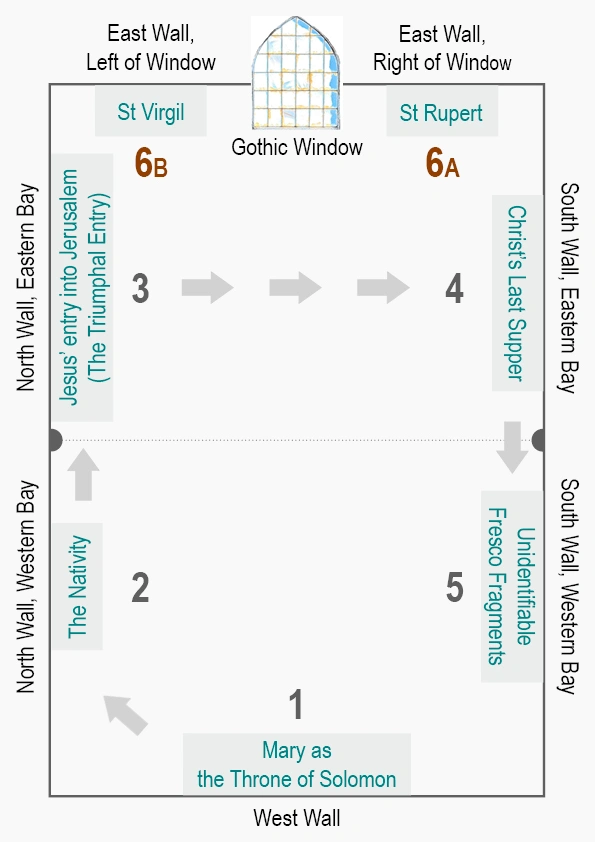
The surviving fresco fragments in Rupert’s Chapel once formed part of a carefully planned Romanesque wall-painting cycle. Together, these images told the story of Christ’s life, from his birth to his sacrifice, while linking this universal Christian narrative to the local church tradition of Salzburg and Carinthia.
“Mary as the Throne of Solomon” was positioned on the west wall. This fresco showed Mary as the Living Throne, holding the Christ Child, regarded as divine Wisdom. The motif expressed the belief that the birth and life of Christ fulfilled ancient prophecy.
Moving along the north wall, scenes of “The Nativity” marked the beginning of salvation history followed by “Christ’s Entry into Jerusalem”, the moment when his public ministry turned towards suffering and death.
On the south wall, the cycle reached its theological centre with “Christ’s Last Supper”, a scene closely connected to the Eucharist celebrated at the altar.
Nearby fragments probably showed a further episode from the Passion of Christ, such as “Gethsemane” or the “Crucifixion”, reinforcing the theme of sacrifice.
The east wall, the liturgical focus of the chapel, displayed Saint Rupert and Saint Virgil, bishops and patrons of Salzburg. Their presence anchored the story of Christ within the regional church and reminded medieval worshippers that their local community stood within a wider Christian tradition.
Although much of the original painting has been lost, the remaining fragments still reveal how image, architecture, and worship once worked together to guide medieval visitors through the Christian year and the central beliefs of their faith.
Romanesque Fresco Cycles in Chapels | Functions
Romanesque fresco cycles in Carinthian chapels told the story of Christ, the Virgin Mary, and the saints.
They served several important purposes:
– Instruction: The frescoes showed biblical events and moral lessons in visual form, allowing even illiterate visitors to understand the teachings of the Church.
– Liturgical guidance: The scenes were linked to feasts and church celebrations, helping worshippers connect the images to the rhythm of the Christian year.
– Devotion: The painted walls created a sacred atmosphere that encouraged prayer, reflection, and reverence.
In this way, the frescoes taught, inspired, and guided visitors in their faith.