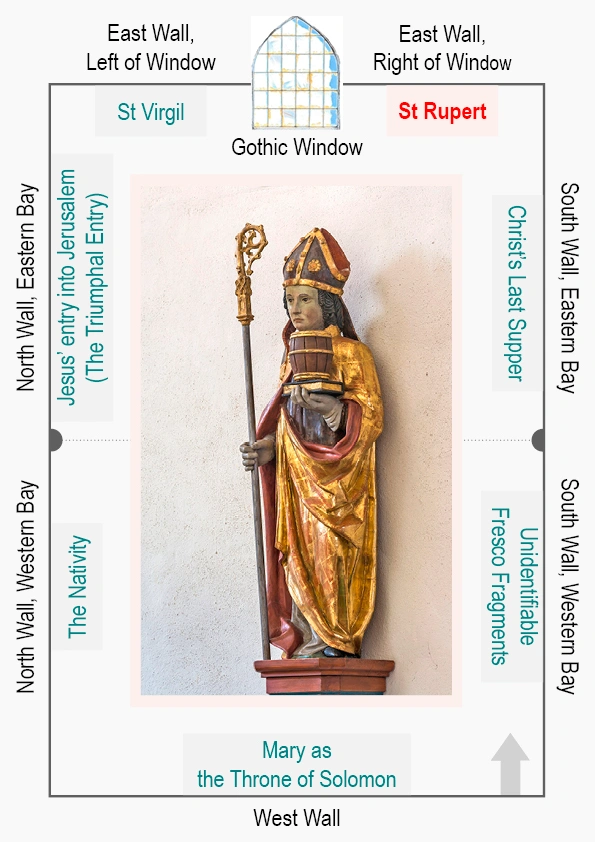


St Rupert of Salzburg (c. 650–718)
Bishop, Missionary, and Founder of Salzburg
Reading Time: 1:15 min
St Rupert is venerated as one of the most important missionary saints of the Eastern Alpine region and is regarded as the Apostle of Bavaria and Salzburg. His life stands at the transition between the late antique Christian world and the early medieval shaping of Central Europe.
Origins and Early Life
According to early medieval tradition, Rupert was born into a noble Frankish family, probably in the region of the Middle Rhine. He received a thorough ecclesiastical education and became Bishop of Worms, where he gained a reputation for learning, pastoral care, and missionary zeal.
Mission to Bavaria
Around the year 696, Rupert was invited by Duke Theodo II of Bavaria to evangelise and organise the Church in the duchy. Rupert travelled south with companions and began preaching Christianity among the Bavarian population, combining missionary work with the establishment of lasting ecclesiastical structures.
Foundation of Salzburg
Rupert chose the site of the former Roman settlement of Iuvavum, then largely in ruins, as his main centre. He refounded it as Salzburg, naming it after the nearby salt deposits that formed the economic basis of the region. Rupert established the Abbey of St Peter, one of the oldest continuously active monasteries in the German-speaking world, and founded a women’s convent at Nonnberg.
Role as Bishop and Organiser
As bishop, Rupert laid the foundations of the Diocese of Salzburg. He promoted Christian education, organised parish structures, and supported economic development through the salt trade, which helped secure the material basis of the Church and the surrounding settlements.
Death and Veneration
St Rupert died around 718, probably in Salzburg. He was buried at St Peter’s Abbey, which became a centre of his cult. His veneration spread widely throughout Bavaria, Austria, and neighbouring regions. Numerous churches and chapels are dedicated to him, particularly in areas connected with early Christianisation.
Iconography
St Rupert is usually depicted as a bishop, wearing a mitre and holding a crozier. He is often shown with a barrel or lump of salt, symbolising the salt mines of Salzburg and his role in establishing the city’s prosperity.
Legacy
St Rupert’s legacy lies not only in his missionary work but also in his lasting institutional foundations. Through the establishment of Salzburg as a spiritual and economic centre, he played a decisive role in shaping the religious landscape of the Eastern Alps in the early Middle Ages.
St Rupert and St Virgil | Joint Depiction
In the Rupert’s Chapel of the Kapellenturm (Chapel Tower) in Friesach, the frescoes of St Rupert and St Virgil are painted together on the eastern wall for the following reasons:
Joint Patronage: St. Rupert and St. Virgil are the primary patron saints of the Archdiocese of Salzburg. Since Friesach was a significant administrative and religious centre for the Archbishops of Salzburg in the Middle Ages (as their oldest city in Carinthia), the chapel honours the archdiocese’s foundational figures.
Historical Succession: St Rupert is regarded as the founder of Salzburg (c. 696), while St Virgil was his most significant successor who completed the first cathedral in 774 and transferred Rupert’s relics there. This historical “bridge” represents the continuity and establishment of the church in the region.
Missionary Legacy in Carinthia: St Virgil is specifically known as the “Apostle of Carinthia” (Apostel Karantaniens) because he initiated the missionary work that expanded the Salzburg diocese’s influence into the Carinthian territory where Friesach is located.
Symbolic Alignment: On the eastern wall, which is traditionally the most sacred part of a chapel (facing the rising sun and the altar), their pairing symbolises the union of the missionary founder (Rupert) and the master builder (Virgil) of the Salzburg Church.
Iconographic Tradition: In Austrian and Salzburg art, the two are almost always depicted as a pair: