Jewish Gravestone 1
Reading Time: 1:54 min
Description of the Gravestone
This fragment of a medieval Jewish gravestone bears a Hebrew inscription.
The epitaph begins with the customary formula “Here lies” and concludes with the traditional blessing “May his soul be bound in the bond of eternal life”.
The lettering is incised within a recessed inscription field, which is framed by a plain raised border band.
Dated
13th–14th century
Technique Used
The gravestone was made with a recessed inscription field (sunken relief) and incised Hebrew script.
Condition of the Gravestone
The stone survives in fragmentary form.
The surface is weathered, and the gravestone is broken horizontally across its midsection.
Description of this Exhibit
This Jewish gravestone belongs to Ascher, the son of Isak.
It dates from 11 September 1399 according to the Christian calendar.
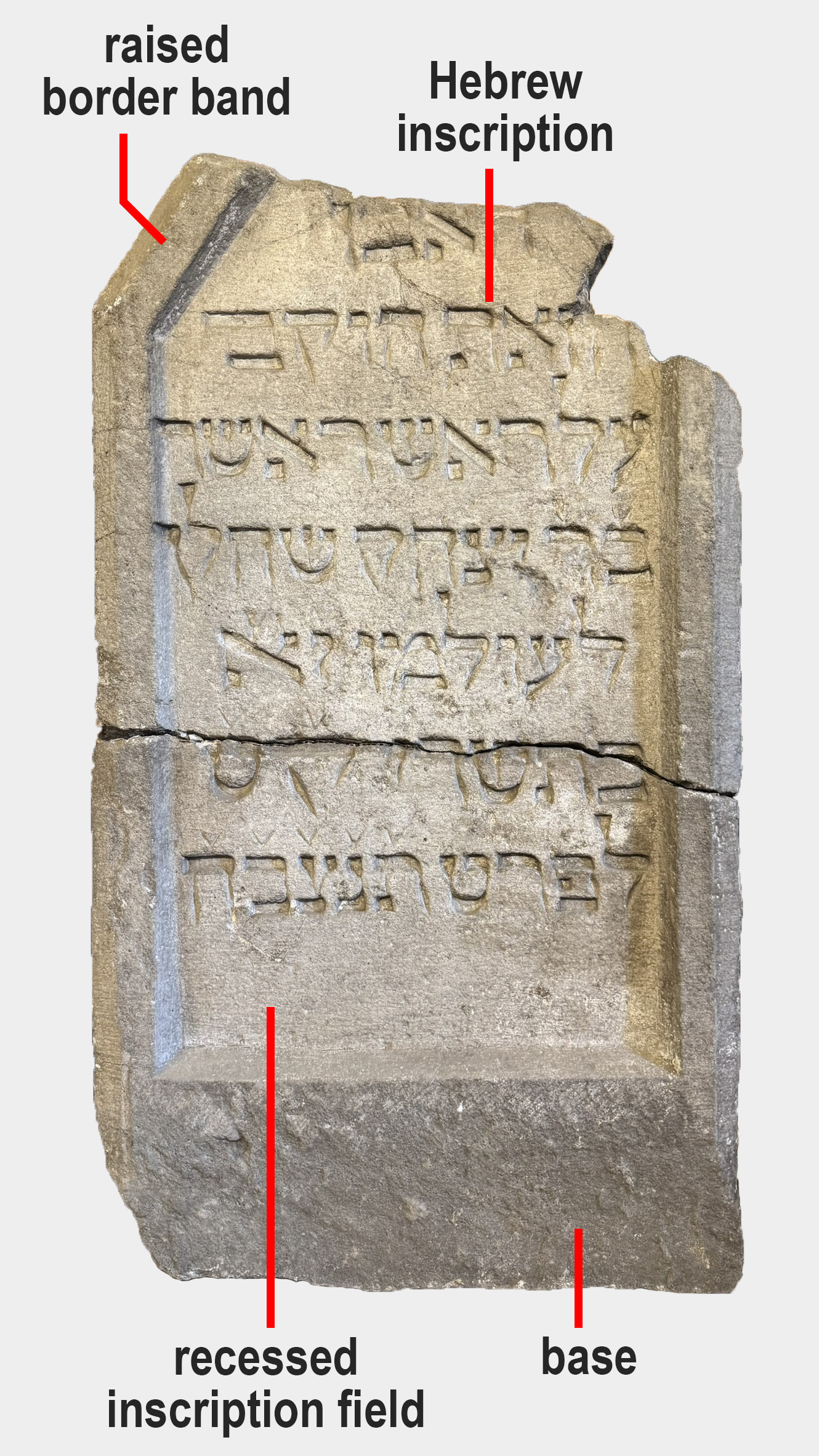
Inscription on the Gravestone
Transcription | Transliteration | Translation
Transcription (Hebrew)
פ״נ
איש חי ורב
מאיר בן אשר
ישר באורחיו
יצחק שוכן
לעולמים
תנצב״ה
Transliteration
Po nitman
’ish chai ve-rav
Me’ir ben Asher
yashar be-or’khav
Yitzchak shokhen
le-‘olamim
tehi nafsho tzerurah ba-tzror ha-chayim
English Translation
Here lies
a righteous and distinguished man,
Meir son of Asher,
upright in his ways.
May Isaac dwell in eternity,
and may his soul be bound
in the bond of everlasting life.
The transcription represents exactly what is carved on the stone in Hebrew characters.
The transliteration presents the same text rewritten phonetically in Latin letters, allowing it to be read or pronounced by those unfamiliar with Hebrew script.
The translation conveys the meaning of the text in modern German or English.
Jewish Gravestones
General Information
Form and Inscription
Jewish gravestones are distinguished by their dignified simplicity and deep symbolism.
Traditionally carved from durable materials such as limestone or granite, they were set upright at the head of the grave.
Hebrew inscriptions usually recorded the name of the deceased, the father’s name, the date of death, and a short blessing for eternal peace.
Symbolism and Meaning
Common motifs include the Star of David, the seven-branched Menorah, and hands raised in priestly blessing, symbolising descendants of the priestly class (Kohanim).
Pitchers represent the Levites, who assisted in Temple rituals.
In different regions, local artistic traditions subtly influenced the shape and ornamentation, though Jewish law generally discouraged elaborate decoration or human figures.
Orientation and Sanctity
Gravestones were traditionally oriented eastwards, towards Jerusalem, reflecting Judaism’s deep spiritual connection with the Holy City.
The cemetery itself was regarded as sacred ground – a place of eternal rest, preserved in perpetuity and treated with the utmost respect.