Clocks
19th C.
Reading Time: 3:40 min
Black Forest Wall Clock
19th Century
General
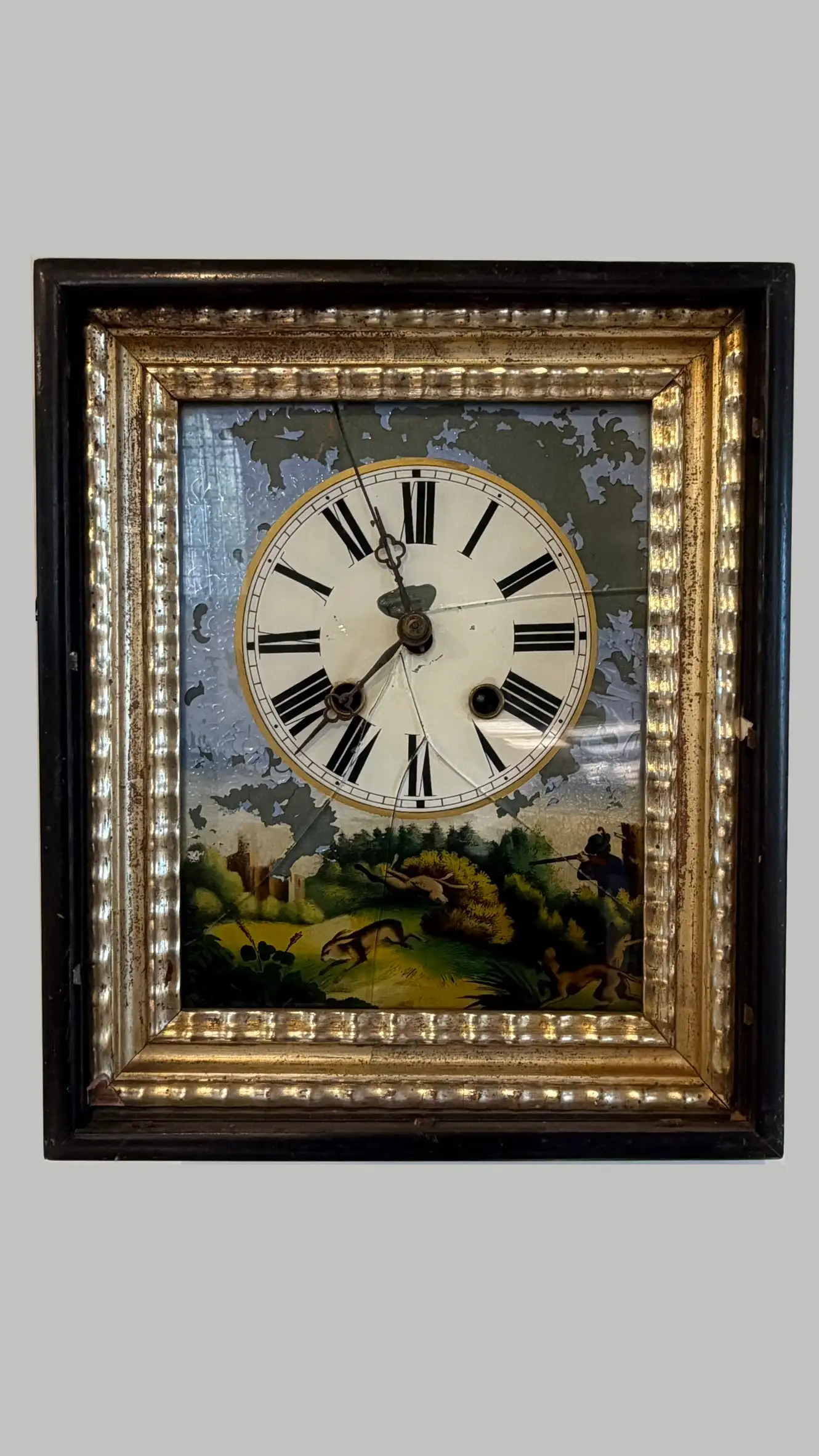
Black Forest wall clock, 19th century, produced in the Black Forest region, a major centre of clockmaking.
Case – Overall Form
The case is conceived as a flat, rectangular frame presenting the clock frontally. Its clear and linear form reflects the functional character of 19th-century wall clocks.
Front
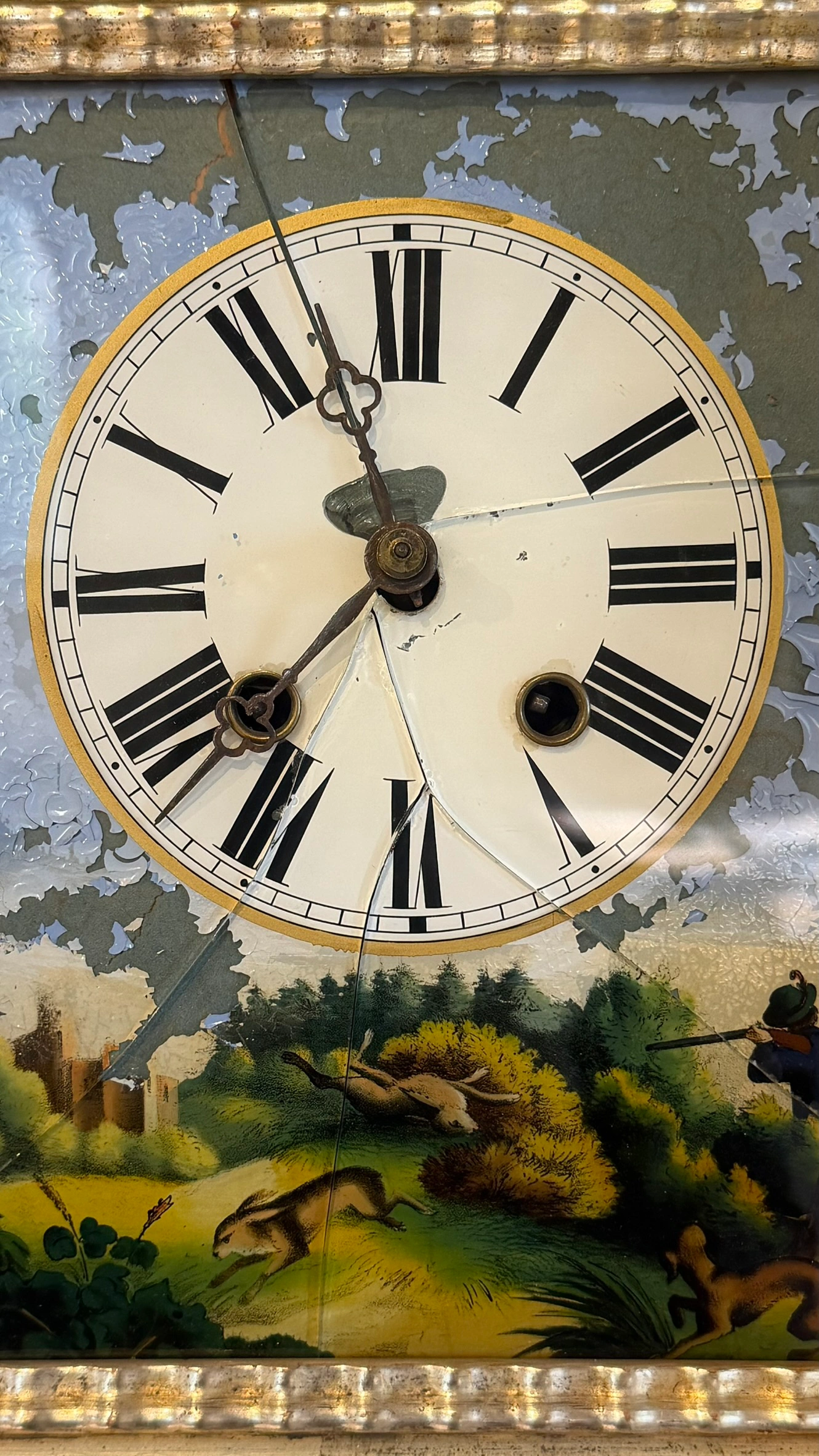
The front is entirely defined by the glazed frame and the dial behind it. The composition resembles a framed picture, combining timekeeping with decorative display.
Main Body
The body is constructed as a frame with a deeply moulded inner section, creating a sense of depth and drawing attention to the centre.
Decoration and Materials
The frame is finished in black polish and highlighted by a gilded inner moulding. The gilding creates a striking contrast with the dark surface.
Dial
The reverse glass dial is painted on the back and incorporates a decorative scene in the lower section (landscape or hunting motif), combining pictorial and functional elements.
Chapter Ring
A clearly defined chapter ring with Roman numerals structures the dial.
Movement
Mechanical movement, typical of 19th-century Black Forest wall clocks.
Striking Mechanism
Half-hour and hour striking on tone springs (gong springs), producing a clear metallic sound.
Use and Placement
Intended for domestic interiors, the clock was mounted on a wall, serving both as a practical timepiece and a decorative element.
Timekeeping
12-hour display with additional half-hour and hour striking.
Biedermeier Column Clock
First Half of the 19th Century
General
Biedermeier column clock, first half of the 19th century. The exact place of production is not recorded, but the type is characteristic of the Austrian–southern German region.
Case – Overall Form
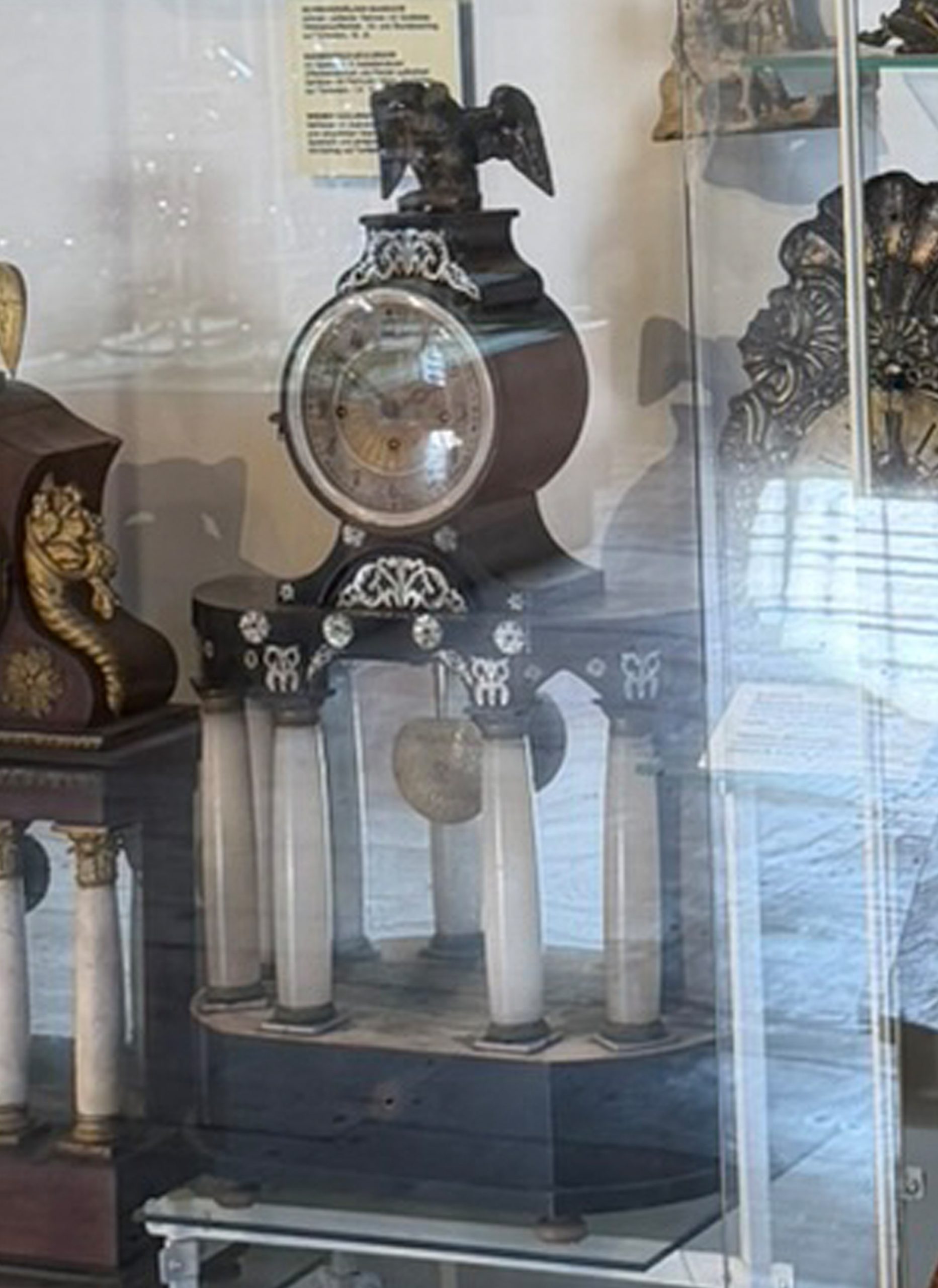
The case is conceived as an architectural composition, consisting of a base, a colonnade, and an upper clock housing. Its clear structure and symmetry reflect the aesthetic principles of the Biedermeier period.
Front
The front is defined by the open columnar arrangement, which allows an unobstructed view of the pendulum. Above it rises the circular clock housing with a glazed front.
Main Body
The main structure comprises a rectangular base supporting a cylindrical or slightly tapering clock housing. The upper section is crowned by a sculptural finial.
Base and Plinth
A broad, moulded base forms the foundation. Above it, a platform supports the columns and the upper housing.
Columns
Six slender alabaster columns support the superstructure. Their regular arrangement lends the clock a light and elegant appearance.
Decoration and Materials
The case is finished in a dark tone and embellished with mother-of-pearl appliqués, creating luminous decorative accents. Additional metal mounts enhance the ornamentation.
Dial
The circular dial is protected by glass.
Chapter Ring
A chapter ring with Roman numerals clearly defines the time display.
Centre
The dial centre is guilloché, featuring finely engraved repetitive patterns.
Viewing Pendulum
The pendulum is fully visible between the columns.
Movement
Mechanical movement with an integrated musical mechanism.
Striking Mechanism
Quarter striking (4/4) on tone springs (gong springs), complemented by the musical mechanism.
Use and Placement
Intended for domestic interiors, the clock would have been placed on a commode, table, or console, serving both as a timepiece and a decorative showpiece.
Timekeeping
12-hour display with quarter-hour striking and an additional musical function.
Viennese Column Clock
First Half of the 19th Century
General
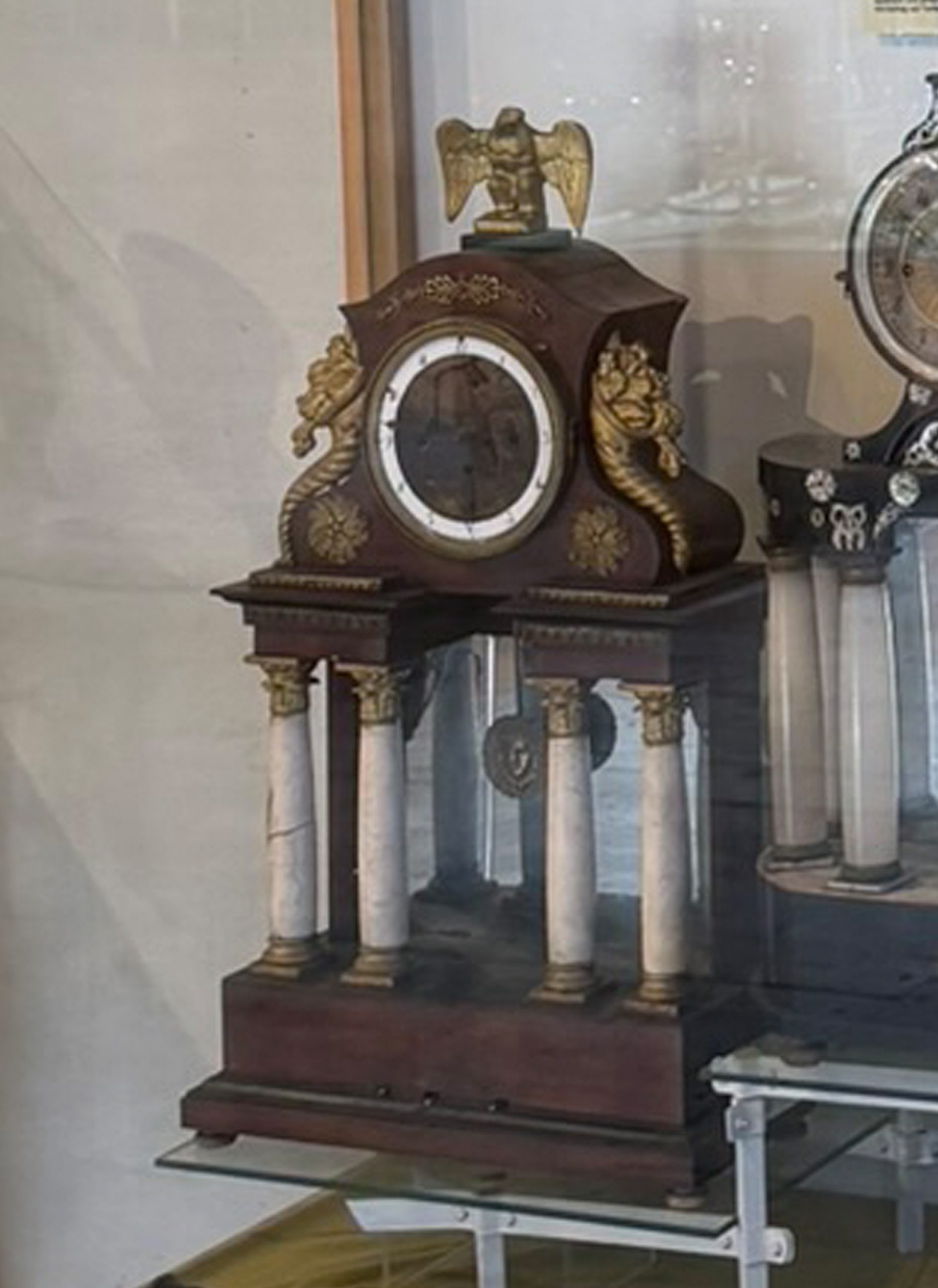
Viennese column clock, first half of the 19th century, produced in Vienna, a major centre of clockmaking during the Biedermeier period.
Case – Overall Form
The case is conceived as an architectural composition with a clearly articulated structure. A rectangular base supports an open colonnade, above which rises the arched clock housing crowned by a sculptural finial.
Front
The front is symmetrically arranged and defined by the open column structure, allowing the pendulum to be seen. The dial is centrally placed and framed by decorative elements.
Main Body
The main body consists of a solid lower section supporting the upper clock housing. The upper part is shaped with a curved outline and crowned by an eagle finial.
Base and Plinth
A broad, moulded plinth provides stability. Above it, a platform supports the columns and the clock housing.
Columns
Several (typically four) columns with light-coloured shafts—likely alabaster or a similar material—support the upper structure. Their capitals and bases are finished in gilt.
Decoration and Materials
The wooden case is richly decorated with gilt cornucopias and gilt brass appliqués. The contrast between dark wood, pale columns, and gilded ornament creates a highly decorative and prestigious appearance.
Dial
The circular dial is set behind glass within the upper housing.
Chapter Ring
A chapter ring with Roman numerals provides a clear and legible time display.
Viewing Pendulum
The pendulum is visible in the lower section between the columns.
Movement
Mechanical movement with an integrated musical mechanism and a simple automaton (moving decorative element).
Striking Mechanism
Quarter striking (4/4) on tone springs (gong springs), complemented by the musical mechanism.
Use and Placement
Intended for refined domestic interiors, the clock would have been placed on a console, commode, or table, serving both as a timekeeping device and a prestigious decorative object.
Timekeeping
12-hour display with quarter-hour striking and an additional musical function.