History
Petersberg Castle in Friesach, first mentioned in the year 860, served as a fortress and residence for the Archbishops of Salzburg. Today, it is a historical museum that presents the diverse history of the region from antiquity to modern times.
History of the Region from 860 CE to 1673 CE
The site was first documented in 860, when King Louis the German granted Archbishop Adalwin of Salzburg a court in Friesach.
During the Investiture Controversy, Archbishop Gebhard of Salzburg took the side of Pope Gregory VII. Around 1076, he had a castle built on Petersberg near Friesach to block King Henry IV’s path over the Alpine passes.
While the area around the castle was at times in the possession of the Bishops of Gurk or the Dukes of Carinthia, the castle likely remained under Salzburg’s ownership.
In 1123/1124, the castle was successfully defended against Duke Engelbert II of Spanheim of Carinthia.
In 1124, Friesach was once again acquired by Salzburg. Archbishop Conrad of Abensberg had the castle extensively expanded.
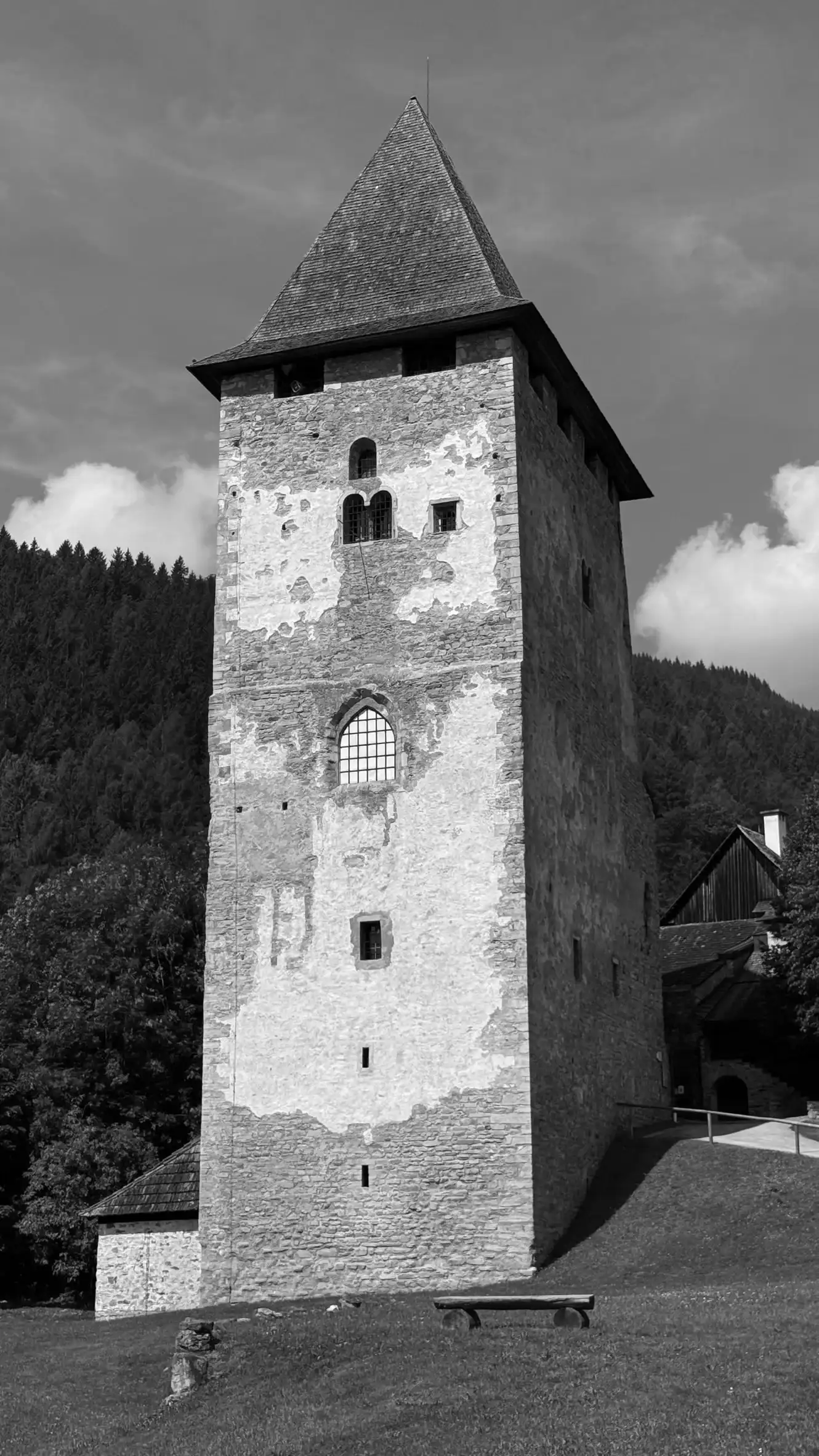
By around 1140, the still extant keep with the Rupert Chapel was constructed. The castle became a secondary residence for the Archbishops of Salzburg and served as a refuge during military conflicts.
In 1149, King Conrad III stayed at the castle after retreating from the Second Crusade.
In 1170, Emperor Frederick I Barbarossa occupied the castle after Archbishop Adalbert III of Bohemia took the side of Pope Alexander III.
In 1192, King Richard I Lionheart passed through Friesach during his flight to England.
During the conflict between Archbishop Rudolf of Hoheneck of Salzburg and Duke Albert I of Austria, the castle was successfully defended against ducal troops in 1292.
In connection with the disputes between Emperor Frederick III and King Matthias Corvinus of Hungary, the castle was occupied by Hungarian troops from 1479 to 1490.
From 1495, Archbishop Leonhard of Keutschach began modernising the castle and gave it, along with the town fortifications, its current appearance.
No longer of military significance, the castle was largely destroyed by fire in 1673. It was subsequently abandoned and fell into decay.
History of the Castle Complex
Today, the castle complex is dominated by the six-storey keep, which was built around 1200 and, after partial decay, was restored from the late 19th century onwards. It housed a monumental chapel (the Rupert Chapel); today, the keep is home to the Friesach City Museum. Immediately next to it are remnants of an even older chapel building (the Gebhard or Conrad Chapel).
Of the buildings that once surrounded the Lower Courtyard, only the building housing the castle administration on the southern side of the courtyard is well-preserved. The long three-storey structure with an arcade front facing the courtyard was constructed in the 16th century. Today, it houses a tavern. The ruins on the west and north sides of the Lower Courtyard are from former representative buildings dating from the 13th to 15th centuries (Palace of Eberhard II, Leonhard’s Building).
West of this is the Upper Courtyard, a large fortified area extending to the rocky peak at the highest point of Petersberg. On the north and south sides of the Upper Courtyard, there are shell towers. The main entrance to the castle was from the west, north of the Upper Courtyard; part of a former gate tower is still preserved there.