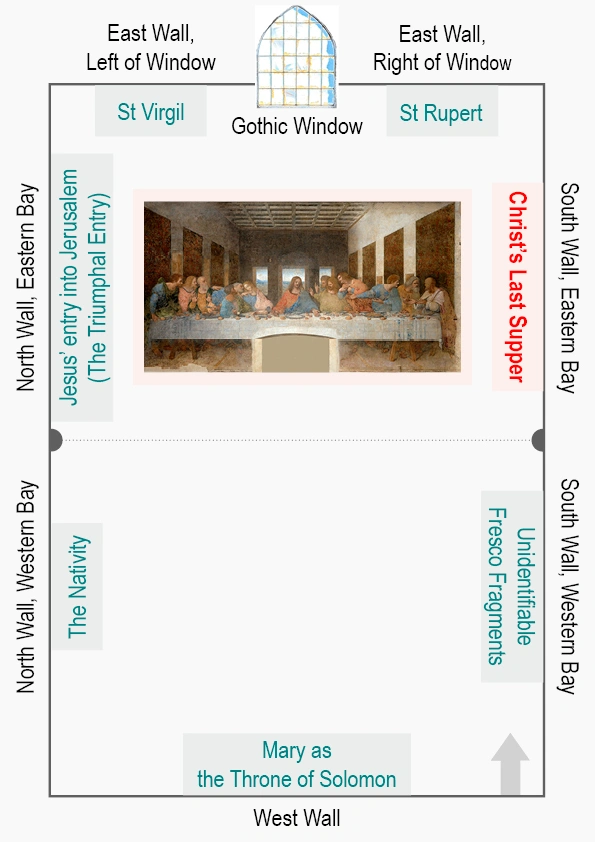


Christ’s Last Supper in Romanesque Fresco Painting
Reading Time: 1:30 min
The Motif
In Romanesque chapel frescoes, Christ’s Last Supper was usually shown as a solemn, symbolic meal rather than a dramatic narrative scene.
Christ sat at the centre of a long or slightly curved table, clearly distinguished by a halo and a calm, frontal pose. The apostles were arranged symmetrically on either side. Judas was often identified by darker clothing, averted gaze, or his position at the near side of the table. Bread, a chalice, and sometimes fish were carefully emphasised, pointing to the Eucharist.
Common Depiction
Romanesque chapels favoured key moments of salvation history rather than detailed storytelling. Scenes were reduced to their essential meaning: the Last Supper, the Crucifixion, the Resurrection, and Christ in Majesty. The focus was on teaching doctrine and reinforcing liturgical ideas for a largely non-literate audience.
Style in Romanesque Frescoes
The style was formal and symbolic. Figures appeared flat and hieratic, with strong outlines, simplified faces, and limited depth. Gesture and expression were restrained. The aim was clarity and spiritual authority, not realism. Space was organised to highlight Christ’s central role rather than natural perspective.
Meaning for the Medieval Chapel Visitor
For a medieval viewer, the Last Supper communicated the institution of the Eucharist. It reminded worshippers that the bread and wine of the Mass were directly linked to Christ’s final meal with his disciples. The image encouraged reverence, obedience, and participation in the sacrament as a path to salvation.
Stage in the Life of Christ
The Last Supper marked the final public act of Christ before his Passion. It stood between Christ’s ministry and his suffering, introducing the themes of sacrifice, betrayal, and redemption.
Relation to the Christian Calendar
The scene was closely associated with Holy Week, especially Maundy Thursday, when the Church commemorates the Last Supper. It prepared the faithful visually and spiritually for Good Friday and Easter.
Relation to Liturgical Traditions
Placed near the altar or in the nave, the fresco reinforced the daily celebration of the Mass. It visually linked the medieval liturgy to its biblical origin, making the Eucharist central to both worship and belief.
The Last Supper in Art
A Familiar Story, Seen Anew by Artists
Reading Time: 1:08 min
The Last Supper shows Jesus sharing his final meal with his twelve apostles before his arrest and death. For Christians, this is a well-known story, but the way it became famous in art is through the many different ways artists have chosen to depict it over the centuries.
Earliest Christian Art
In the earliest Christian art, Jesus and the apostles were shown in a very simple, symbolic way. The figures were arranged clearly around a table, with little detail. The main aim was to make the scene easy to recognise.
Middle Ages
During the Middle Ages, artists began to show the scene with more human detail and emotion. Jesus was usually placed in the centre, and the apostles were shown talking, reacting, and gesturing. This made the image feel more like a real moment among people.
Renaissance
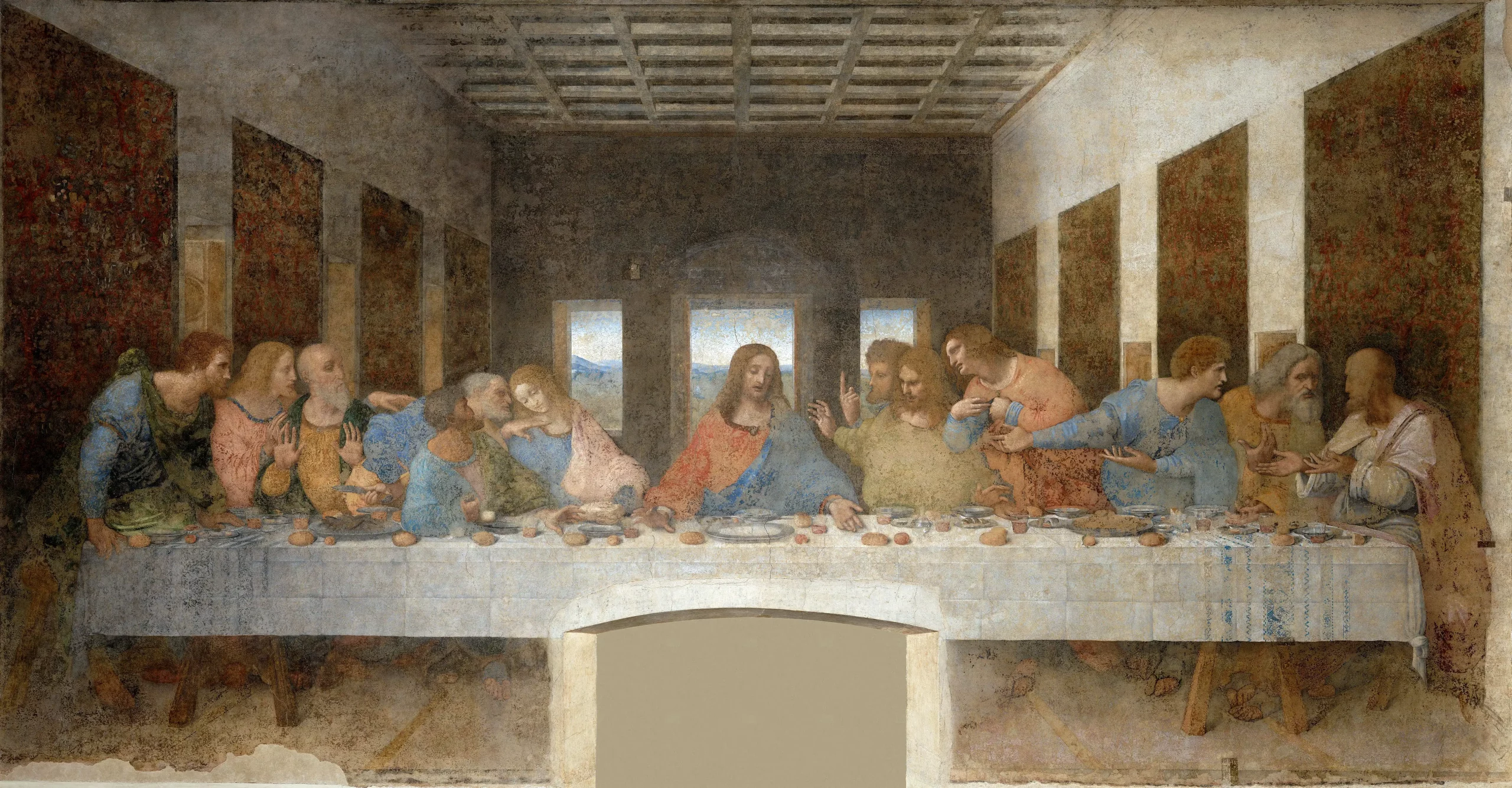
In the Renaissance, the Last Supper became a major artistic subject. Artists used perspective and realistic detail to create depth and make the scene look more like real life. Leonardo da Vinci’s famous version shows a powerful moment of reaction, with each apostle responding in a different way.
Post-Renaissance
In later centuries, artists continued to reinterpret the scene in new styles. Some made it more dramatic, others more simplified, and some even placed it in modern settings.
Today, the Last Supper is one of the most recognised images in Christian art. Its enduring power comes from the way it captures a moment of community, loyalty, and human emotion, as well as the deep meaning Christians attach to the story.