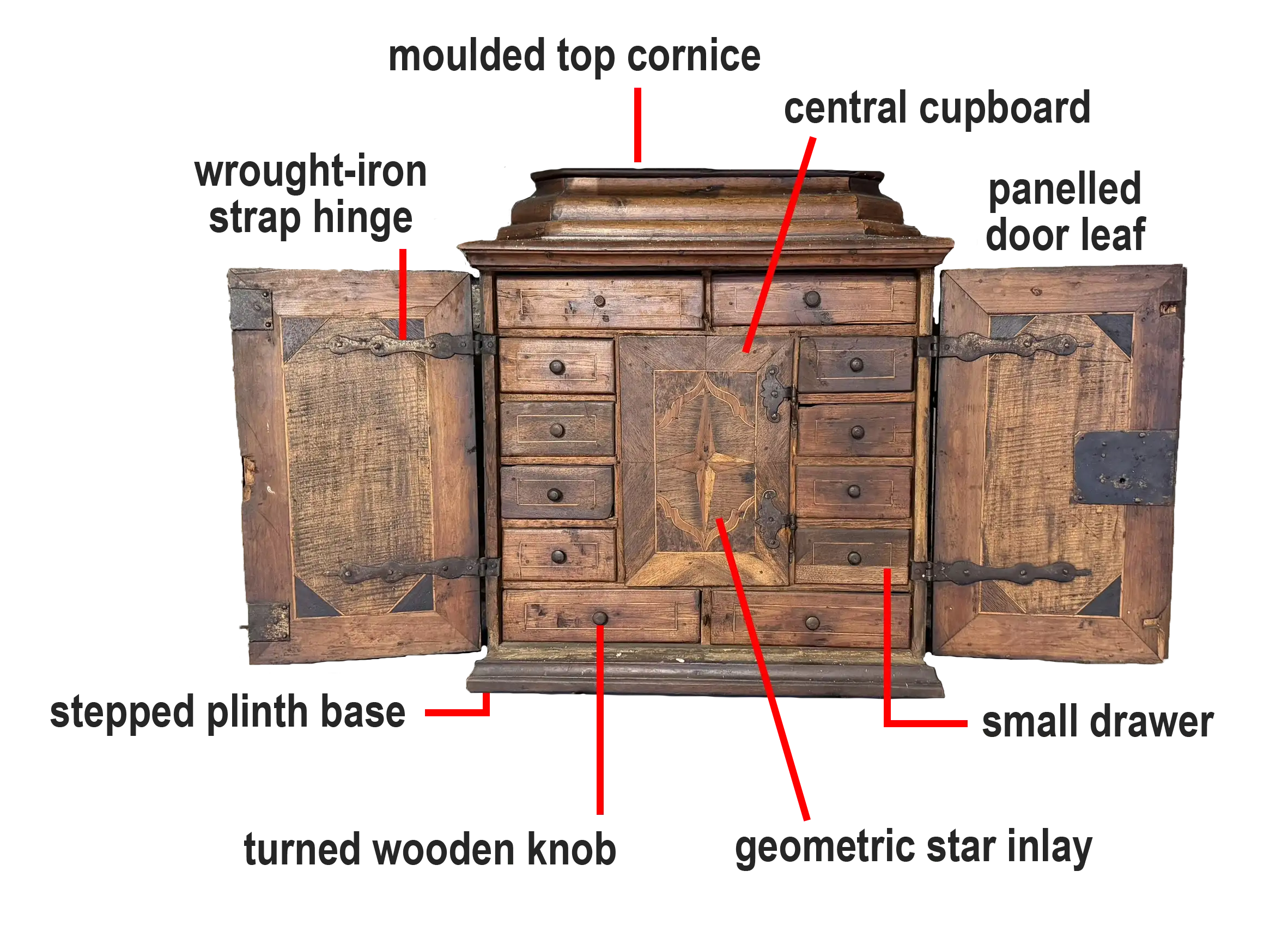
Cabinet Casket, c. 1750
Reading Time: 1:10 min
Cabinet Casket | Craft Techniques
Cabinetmaking (joinery) involved the construction of the carcass, doors, and drawers, including the complex internal layout.
Veneering and marquetry provided the geometric inlay, achieved through the application of contrasting wood veneers.
Wood carving and moulding shaped the moulded edges and the upper section of the cabinet.
Blacksmithing produced the wrought-iron hinges, locks, and fittings, ensuring both strength and security.
Turnery was used to create the small, turned drawer knobs.
Fine cabinet work enabled the construction of concealed compartments, demonstrating precision and ingenuity.
Cabinet Casket, c. 1750
Short Description
This mid-18th-century cabinet casket combines practical storage with private devotion.
Behind its hinged doors lies a carefully organised interior of small drawers and concealed compartments, designed for safeguarding valuables and personal items.
At its centre, a cupboard likely served as a domestic altar, reflecting the importance of faith within the household.
Crafted in wood and reinforced with wrought-iron fittings, the piece is both functional and decorative.
The geometric inlay and balanced arrangement of drawers demonstrate skilled craftsmanship, while the hidden compartments add an element of ingenuity typical of such intimate furniture.
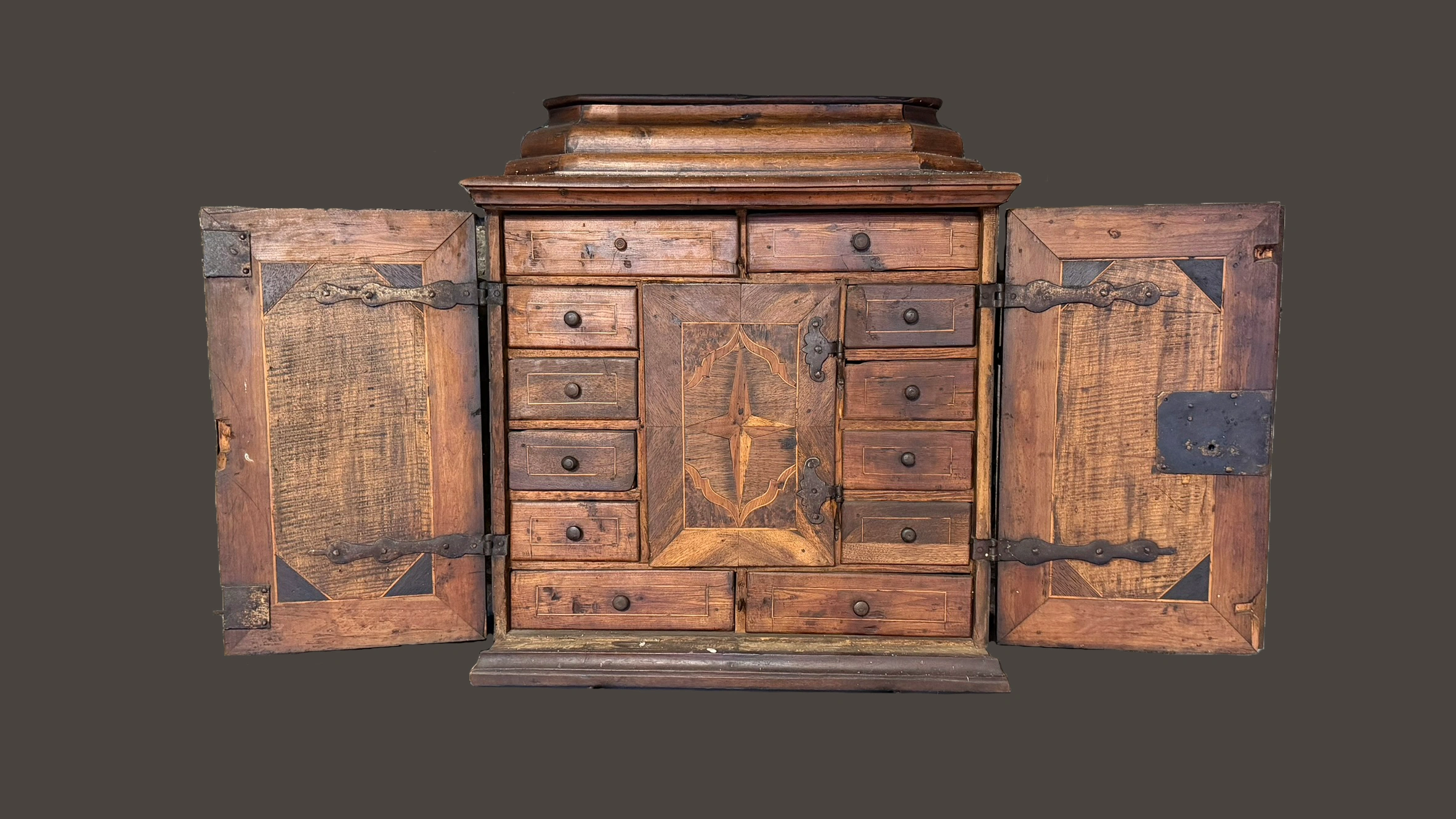
Detailed Features of the Cabinet Casket
Doors and Fittings
The hinged doors are the two outer doors on the left and right sides of the cabinet, which open outwards from the central section.
The wrought-iron strap hinges are the long, horizontal iron hinge straps fixed across the outer faces of each door, connecting them to the cabinet frame.
The panelled door leaves are the wooden door surfaces themselves, each constructed with inset panels framed by stiles and rails.
Central Section
The central cupboard (altar compartment) is the compartment in the middle of the cabinet, behind the small central door, likely intended for devotional objects.
The geometric star inlay is the star-shaped marquetry motif on the front of the central cupboard door.
Storage Elements
The multiple small drawers are the numerous small drawers arranged symmetrically around the central cupboard, both to the left and right and along the bottom row.
The concealed compartments are hidden storage spaces integrated behind or within the drawers and central cupboard; they are not immediately visible but are typical of such cabinets.
The turned wooden knobs are the small, rounded drawer pulls centred on each drawer front.
Structure
The moulded top cornice is the projecting, shaped uppermost section forming the top of the cabinet.
The stepped plinth base is the base at the bottom of the cabinet, formed in receding levels that step inward towards the body.