Friesach in the Early Middle Ages
Focus: Slavic Tribes | King Ludwig | “Salzburger Markt” | Saint Hemma
Reading Time: 0:50 min
In the late 6th century CE, Slavic tribes migrated to Carinthia and settled in the Friesach area. Accordingly, the name “Friesach” is of Slavic origin (from “Breza” = birch or “Breg” = shore, meadow).
Under Carolingian rule, Bavarian and Frankish settlers were granted royal estates as fiefs. In 860 CE, Friesach was first mentioned in a document. King Ludwig the German (843–876 CE) granted the Archbishop of Salzburg, Adalwin, a manor near Friesach, among other gifts. Around this royal estate, which was presumably located in the area of today’s Fürstenhof, the “Salzburger Markt of Friesach” developed over time.
At the same time, in the south, on the opposite bank of the Metnitz River, in the area of present-day Grafendorf, another settlement named Friesach was established, belonging to the Count of Friesach-Zeltschach.
Through the gifts of Saint Hemma, this property was transferred to the suffragan diocese of Gurk, founded in 1072 CE. A prolonged struggle ensued between the Archbishops of Salzburg and the Bishops of Gurk for control of the Friesach region.
Friesach in the Early Middle Ages
Focus: King Ludwig | Archbishop Gebhard of Salzburg | Investiture Controversy
Reading Time: 0:55 min
Around 740 CE, Bavarians crossed the Central Eastern Alps and settled among the Slavic Carantanians. In 860 CE, King Ludwig the German of East Francia granted the lands of the estate “ad Friesach” in the Bavarian March of Carinthia (Carantania) to Archbishop Adalwin of Salzburg.
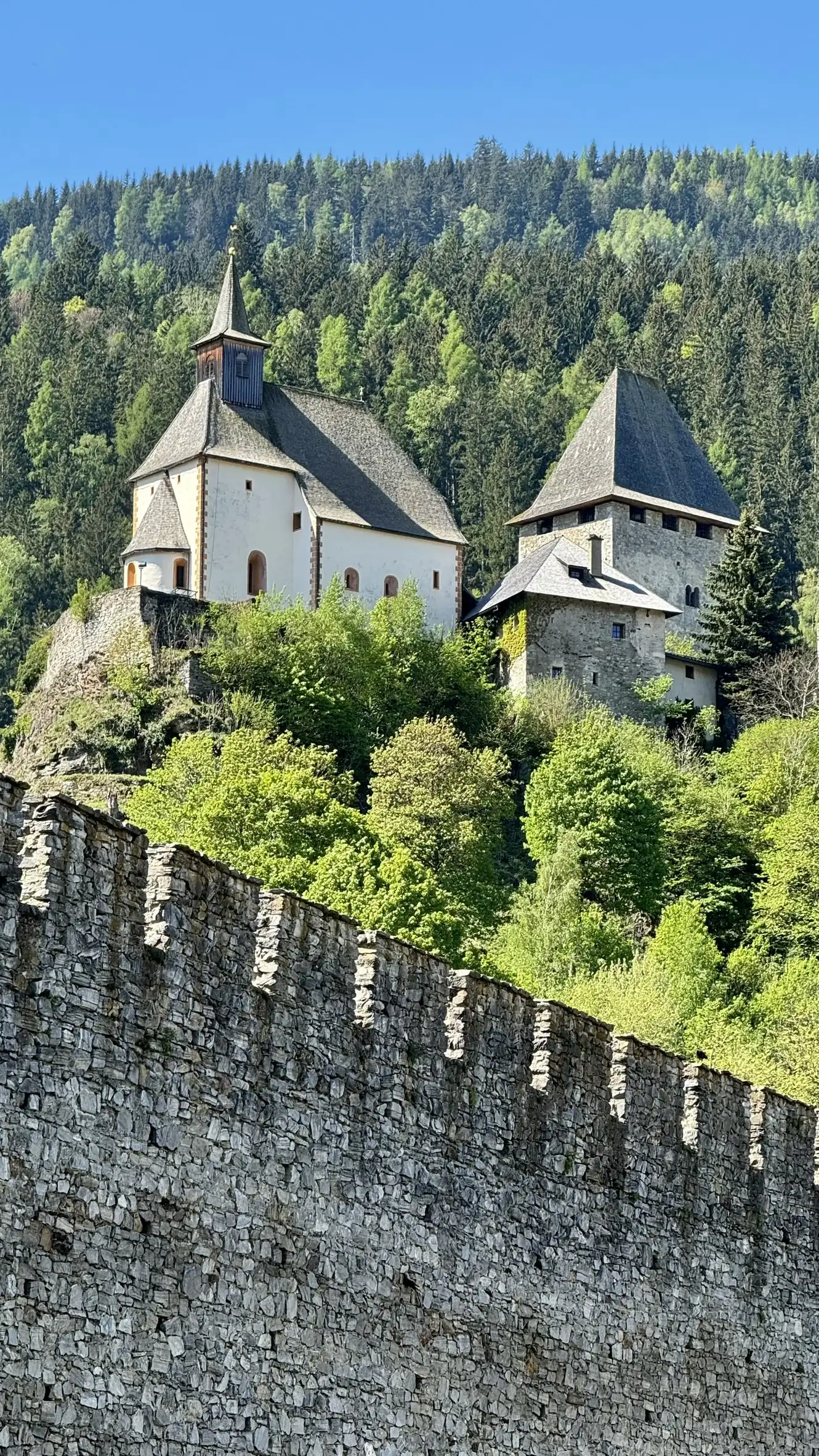
Following the formation of the Duchy of Carinthia in 976 CE, Friesach remained part of Salzburg and continued to serve as a strategically important outpost. In around 1076 CE, Archbishop Gebhard of Salzburg, a supporter of Pope Gregory VII during the Investiture Controversy, had the Petersberg fortress constructed above the town to prevent Emperor Henry IV from crossing the Alps.
The archbishop also faced fierce opposition from the Carinthian Ducal House of Sponheim, whose members, following his deposition, repeatedly attempted to seize control of Friesach. Persistent attacks by Duke Engelbert were eventually repelled in 1124 CE.
In 1149 CE, King Conrad III of Germany stayed at the castle on his return from the Second Crusade.
Similarly, in 1192 CE, Richard the Lionheart sought refuge at the castle on his return from the Third Crusade, attempting to evade the guards of Duke Leopold V of Austria.