Viennese Column Clock, Early 19th C.
Reading Time: 1:30 min
Overall Form and Structure
The clock is designed as a miniature architectural portal, with four slender columns supporting an upper housing. The structure is symmetrical and vertically oriented, creating a dignified and balanced appearance.
Dial and Movement
At the centre is a circular dial with a narrow chapter ring, which allows a partial view into the movement behind. This open aspect emphasises the mechanical craftsmanship. The clock is a one-day movement, meaning it requires daily winding.
Automaton Feature
Within the dial is an automaton scene featuring a blacksmith and a grinder. These figures would have moved in coordination with the clock’s mechanism, adding a dynamic and entertaining element to the timepiece.
Striking Mechanism
The clock is fitted with a 4/4 striking system on gong springs, producing a clear tonal signal at each quarter hour.
Materials and Decoration
The case combines dark-stained wood with gilded or brass elements, particularly around the dial and decorative details. The columns have a lighter tone, creating contrast and enhancing the architectural effect.
Maker and Date
The clock is signed “P. Rau in Wien” and dates from the early 19th century, placing it firmly within the Viennese Biedermeier tradition.
Character and Significance
This clock exemplifies the fusion of architecture, mechanics, and decorative art typical of Viennese craftsmanship of the period. Its combination of clear structural design, visible mechanism, and lively automaton makes it both a technical object and a refined interior ornament.
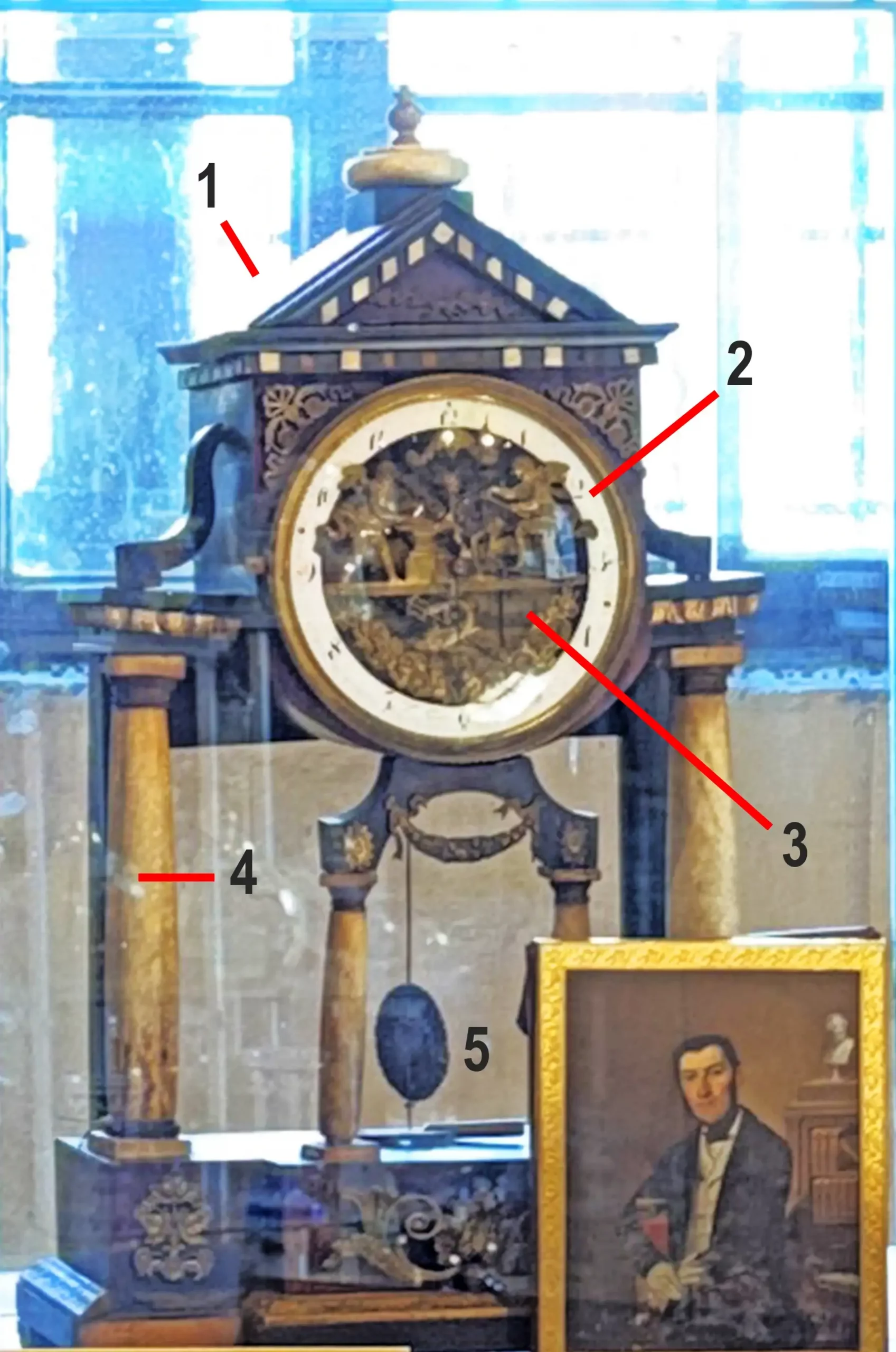
1 | upper housing
2 | narrow chapter ring
3 | visible clock’s mechanism
4 | column
5 | pendulum’s weight (bob)
What is a Viennese Column Clock (Portal Clock)?
A Viennese column clock, also known as a portal clock (Portaluhr), is a distinctive type of early 19th-century clock developed in Vienna, particularly during the Biedermeier period.
Its defining features include:
Architectural Design
The case resembles a small classical portal or gateway, typically four columns supporting an upper section.
Open or Semi-Open Structure
The movement is often partially visible, reflecting both technical pride and decorative intent.
Refined Proportions
Elegant, restrained forms in keeping with Biedermeier aesthetics.
Automata (in some clocks)
Moving figures, such as craftsmen, integrated into the dial or case.
Striking Mechanism
Often equipped with a musical or tonal strike, such as gong springs.
Function and Decoration
These clocks were both functional timepieces and decorative objects, intended for display in bourgeois interiors.