Skip to content

Historical Development of the Town of Friesach | Four Phases

The Friesach Markets, 860 – 1180 CE | Map Legend
Reading Time: 0:25 min

Phase 1
The court at Friesach, located near the present-dayFürstenhof“, was first mentioned in a document in the year 860 CE.

Phase 2
The Salzburg market was located to the north of the present-day main square.

Phase 3
The Gurk market, located in the area of the present-day Grafendorf, was first mentioned in 1028 CE and was destroyed in 1124 CE by Archbishop Konrad I.

Phase 4
The Gurk market, to the south of the current main square, was rebuilt between 1124 and 1130 CE and was under Salzburg’s rule by 1180 CE.
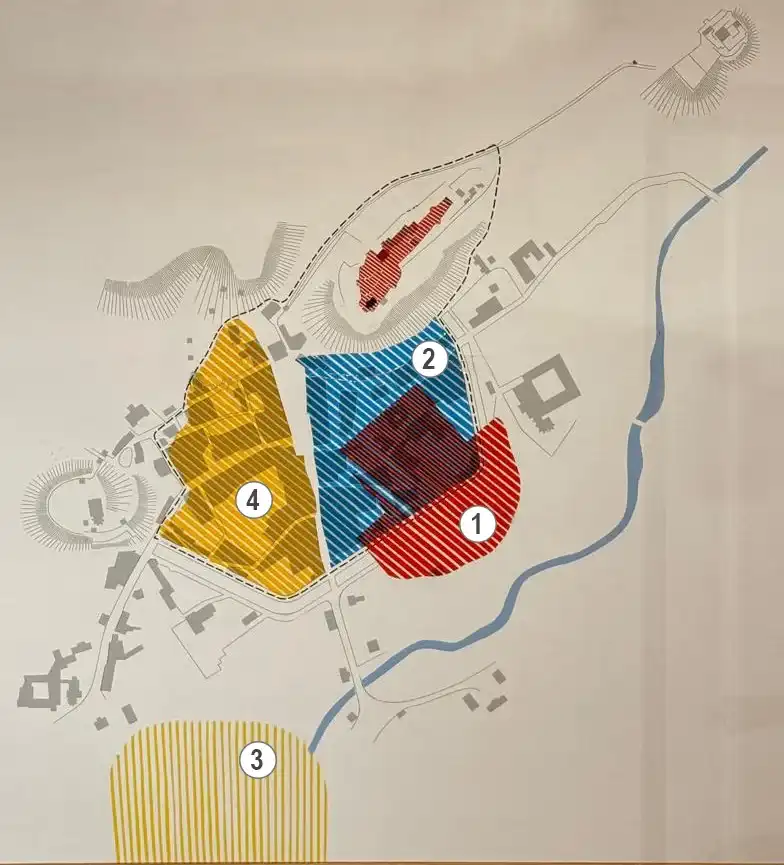
The Friesach Markets
Reading Time: 0:55 min

The settlement of Friesach, beneath Petersberg Castle, received town privileges in 1215 CE. During the Middle Ages, it was a principal market town and commercial centre due to an important trade route from Vienna to Venice that ran through the city.

The town flourished when Archbishop Eberhard II of Regensberg (1200–1246 CE) made it the second-largest town in the Archdiocese of Salzburg and the most important town in Carinthia.

From local silver resources, it even minted its own currency called the Friesacher Pfennig or Frizatik, widely used within the Austrian and Hungarian lands in the 12th century CE. The town gained regional importance, and by the 13th century CE, the Friesach pfennig was the standard coin used in the eastern Alps. It circulated as far as Croatia.

The importance of the town diminished with the rise of the House of Habsburg. However, the fortress in Friesach continued to be an important power base for the Salzburg prince-archbishops throughout the Middle Ages. It was enlarged and strengthened by Leonhard von Keutschach from 1495 CE onwards.

Friesach belonged to Salzburg until the secularisation of the archbishopric in 1803 CE, when it finally became part of Carinthia.